By Roland Betancourt

With the inauguration of Lady Gaga’s ARTPOP project, we could begin by going through the usual litany of complaints about its potential shortcomings: for example, criticizing any collaboration with Marina Abramović as overwrought and outdated – after all, Abramović isn’t necessarily cutting-edge, avant-garde, or whatever inadequate term we might want to use. And this complaint is a valid one: if Gaga is attempting to bridge some sort of gap between Art and Pop, to insert art into pop, rather than just pop into art, shouldn’t this process involve artists that are not just vibrant in pop-culture like Abramović, but who also have a force of their own within art circles beyond the grasp of a blockbuster retrospective. That being said: where are other great clichés, such as Matthew Barney, Gerhard Richter, Linda Benglis, and, yes, even Damien Hirst?
Nevertheless, in the end the specifics of these artists – their inclusion or exclusion – are ancillary to this project, precisely because here the well-known artist functions as a sort of relic: that is, as some little scrap of wood or bone that, while lending validity and agency to the entire system, is actually negligible; the reliquary is what truly serves as the generator of meaning – for without it how would a worshipper even know that the relic is indeed a relic (miracles not withstanding)? I set up this bad metaphor only to point out that in a project such as ARTPOP what really comes to bear serious weight is not what constitutes art (or rather who), but rather what constitutes pop.
Often times, it seems that discussions on popular culture (or, quite simply, pop) treat pop as a monolithic phenomenon. With this, I am not trying to say that pop is often seen as some sort colonized, orientalist frontier with prescribed characteristics and common trends. Instead, I am more concerned with pop’s amorphous character and – mainly – with its anachronistic, outdated construction. The pop that was in Andy Warhol’s art is not the pop that is now in Lady Gaga. While the two may at times share common critical terms and keywords, these two entities are infinitely diverse and the definitions and connotations of such terms and keywords have radically changed.
Therefore, it is necessary for us to stop and ask: what is the location of pop? Or, perhaps even more broadly: what is popular culture today?
Taking Gaga as a route for this analysis, we can begin with a crucial observation regarding what exactly constitutes the medium of pop beyond its amorphous definition as encompassing all visual and material culture that is popular or in the public domain. Now, I am going to say something that will not surprise anyone, the banality of which may perhaps make one cringe: looking at Gaga’s past and current work (including what little there is of ARTPOP today), it seems to me that what constitutes as pop for Gaga is fandom. Pop is the holistic experience of the fan. So when “Applause” came out, with its blatant embrace of this banal fact, it may have caused many to roll their eyes. Nevertheless, if we take this banality seriously, we come across a whole pop phenomenology that has been left unaddressed by most projects dealing with Gaga’s work.
What then is the experience of the fan (if we consider the phenomenon comparatively across a variety of interrelated sources), and how has the medium of popular culture presented itself as a unified entity within the work of Gaga and her peers?
Here, in Part I of this inquiry, I wish to consider the medium of pop: the smartphone, and by extension the tablet and other mobile digital devices. The experience of the fan unfolds primarily in movement and circulation through mobile media. It is the method of the navigator: the incessant movement through space and time, consuming and representing images, clips, and laconic texts as one goes about. This is the domain of Instagram, Twitter, Vine, Facebook, and Tumblr. But it is not the domain of those who use these media periodically, for instance only when something pops up on their Facebook feed or when something goes completely viral. Rather, this is the kingdom of those who fervently filter their pics onto Instagram, tweet their celebrities, create seven-second videos, and make gifs of their favorite YouTubers. This is the location of pop, this is the kingdom. It is a thriving underworld of videos and quasi-celebrities that exist right at the brink of virality.
Katy Perry has been one of the artists who has best seized this site, particularly in her “Roar” lyric video, which is constructed as a first-person perspective of an iPhone 5 chat experience. The video begins with the familiar ring of the iPhone, and positions the viewer from the perspective of Katy Perry as she unplugs her phone and begins chatting. The video then follows her through a series of private and public spaces, and all the while the chat stops and resumes throughout her day – the movement of time being articulated by the phone’s clock.
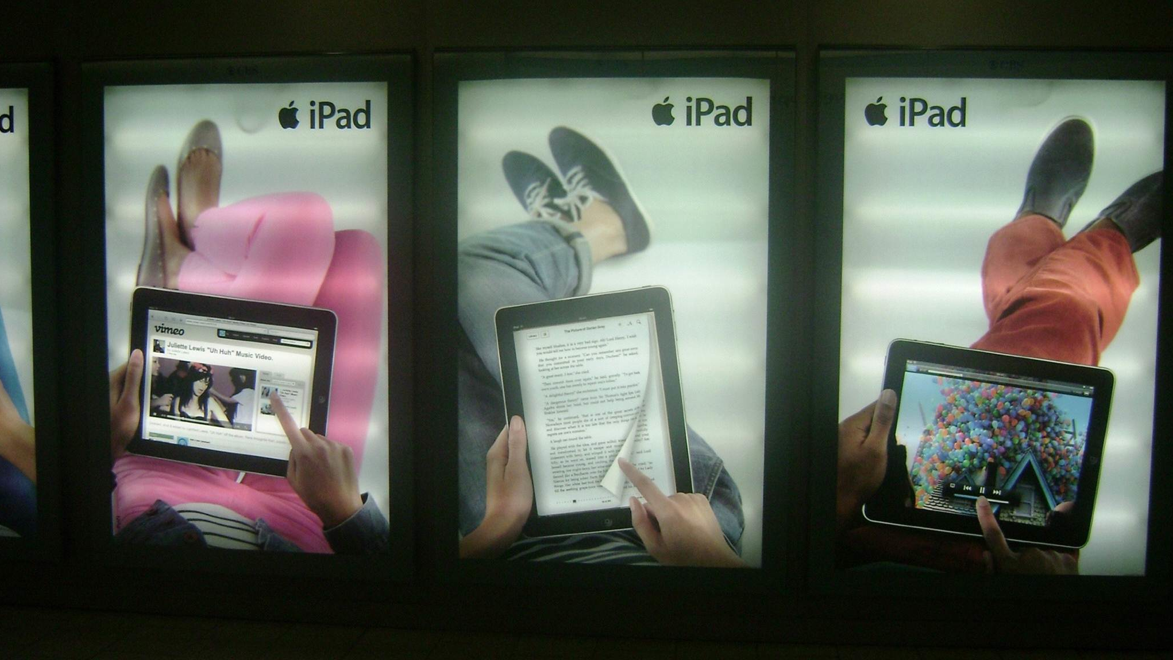
This first-person perspective has been Apple’s consistent advertising trope for the iPad since its inception. As I have discussed elsewhere, the first-person sensual experience was the key selling point in the first iPad’s advertising campaign. The campaign’s advertisements all featured casually dressed bodies utilizing the iPad in a variety of manners that featured its various tools and features. In typical Apple fashion, the iPad ads would often be displayed serially, thus conveying the gamut of possibilities offered by the new tablet technology – along with its new requisite gestures (pinching, swiping, scrolling). These bodies were headless, which allowed for the ad’s viewers to place themselves in the position of the user – as if already playing with their new gadget in their encounter with the image.

During this initial campaign, I encountered an iPad (1) ad with the phrase “iHomeless” scribbled on it over a subway stop in Chelsea, NYC. This piece of graffiti plays with the distinctive “i”, (a linguistic shifter), in Apple iTechnology branding – the “i” that advocates the very personalization of experience that the iPad ad conveys. This scribbling on an advertisement for the latest gadget is a poignant reminder of poverty in light of excessive consumer consumption and commodity fetishes — particularly in a city like New York. However, it also demonstrates the Apple brand and its technologies as a locus for image-based socio-political activism. This, for example, was quite evident in the immediate aftermath of the invasion of Iraq and the Abu Ghraib Scandal, when a series of viral posters emerged that bore the images of Abu Ghraib and soldiers, stylized in such a way to mimic the popular color-and-silhouette iPod ads. The iRaq posters, as they were called, were interspersed among the Apple advertisement campaign as a form of viral resistance, a tactic that paralleled Apple’s own strategies.

The Katy Perry video operates on the same order, deploying Apple’s advertising strategy for the iPad, which in a sense has become synonymous with the experience of mobile technologies. Additionally, its continued existence as a common image throughout cityscapes has enhanced this trope as a popular image. But here, the image is not merely representational of an iconic feature, person, or object. Instead, these images are iconic representations of an experience, of the habitus of mobile technologies – emblems of the phenomenology of pop.
In 2010, M.I.A. deployed a similar approach in her “XXXO” music video, which presented her image utilizing a MySpace aesthetic – featuring glimmering .gifs of roses and Arabic, reminiscent of the images that thrived during the height of MySpace, a phenomenon that faded (except perhaps on forums) after the rise and takeover of Facebook’s dogmatic architecture – and which also faded along with the .gif until its recent re-emergence.
The video features a mise-en-abymeof M.I.A. singing as a YouTube video floating throughout this utopic space. It stresses the MySpace connection at the end with its closing .gif that reads “Thank you for adding me,” which was a common custom on MySpace.


However, unlike Katy Perry’s “Roar,” M.I.A. opted for an aesthetic approach to the social networking site – akin to the short-lived Seapunk trend – rather than deploying its equally iconic habitus.
In Perry’s video, the lyrics unfold through the interchange of the chat and through the mediated use of emojis – the direct descendant of the emoticon; the musicality of the score is articulated through the emojis’ pulsations, repetitions, and ancillary emojis (such as the combination of the lion, megaphone, and explosion to signify the extended “roooooooooooar”). Note, however, that the chat is not the iPhone’s iconic native chat app, but rather speaks to the rise of supplementary chat apps, such as Snapchat and WhatsApp, an issue usefully explored by Parmy Olson on Forbes. As such, Katy Perry’s video offers an insightful reflection on what precisely is the medium of pop today and how pop articulates itself. This has always been Katy Perry’s strong point: her ability to actively respond to pop culture on its own contemporary terms, and thereby capture the reality of a fan-based habitus.

The depiction of the iOS particularly stresses this point. On the one hand, it features the standard elements of the iPhone iOS’s top bar with the signal meter, carrier, connection quality, time, and battery meter on the light-blue (from left to right). The video’s designers have paid close attention to these elements. For example, the battery meter also goes down as the day goes by – the conversation starting and ending at different points throughout the day. Her battery dramatically goes down following moments when she does not have a charger handy – i.e. when she is at the gym or in the car. Also note that the carrier is KT&P – a riff on AT&T, which for a long time served as the exclusive iPhone carrier. But perhaps even more fascinating is the fact that while at home or at the gym she is connected to a WiFi network, while in the car the connectivity switches over to “PSM,” standing for her upcoming album Prismfrom which the single derives – and then goes back to WiFi when she returns home. Finally, notice that the proportions of the video match the 4” display proportions of the iPhone 5 (particularly evident when full screened), a feature that looks odd when viewing the video on the iPhone 4S, for example.
 |
| iPhone 5 view |
 |
| iPhone 42 view |
While we could easily dismiss these as fillers, the care with which the designers of the video approached these elements is worth acknowledging and considering as either implicit or explicit indicators of Katy Perry’s role in the construction of a discursive space enabled by the “Roar” chat app. Here, the artist is put in the place of the network – that is, the immaterial medium of discursive unity and connection – while the signal strength and connection indicate a local network or the album itself as the quality of the connection. This indicates that Katy Perry herself is the wider system of connectivity, while her album Prism serves merely as one of a variety of connectivity strengths or options – let’s consider PSM the LTE of the Katy Perry network, the newest, fastest, and most advanced iteration of networked connectivity. Here Katy Perry has discretely, but quite articulately, captured the experience of the fan as an entity that is not singular, but always caught within a larger sphere of discourse. The contemporary pop artist operates as a carrier for that conversation with each successive project or album reflecting changes and improvements of technological prowess and connective quality.
Following the video’s release, there has been some controversy regarding its originality – criticized as being ripped off from Dillon Francis’s official music video for “Messages (ft. Simon Lord).”
Here we encounter one of the biggest arguments in pop fandom: the question of originality and rip-offs. We’ve heard it with Madonna and Gaga, for example, and it is perhaps one of the most detrimental discussions out there for the consideration of popular culture. The Dillon Francis video is a perfect example of this, because while it did come first, it does not feature a careful or concerted understanding of the iPhone as a specific technology.

The video does not try to emulate the experience of the iPhone, as made evident by the opening shots where the credits are presented as an iPhone badge alert, with the iPhone’s installation progress bar below and moving emojis in the background. The badge is out of proportion and forced, and the status bar and emojis are elements that you would never see on the home screen. This is not to say that a successful video need replicate exactly the iOS in some banal trope of medium-specificity; however, what this demonstrates is the fact that this video – like the M.I.A. video – is approaching the medium only from an aesthetic or stylistic standpoint, and does not desire to deploy existing iconographies and image systems for generating meaning. It is a song entitled “Messages,” so the artist here decided to make a video that alludes to elements of messaging systems – it is quite an overly literal approach.

Furthermore, the video does little to postulate a non-native or specific chat app, deploying the Apple chat bubbles in an abstracted iPhone space that does not even have a control bar for the chat application – and the battery meter above it stays at a steady 62% throughout. In as much as the Katy Perry video consistently demonstrates an overarching logic to its design, this video, on the other hand, consistently demonstrates a loose deployment of the iPhone trope in its lack of attention to detail. This is not to say that this video is necessarily lesser, but rather that its goals are wholly different, and that it does not achieve the cohesive unity and complexity that the Katy Perry lyric video achieves within this context. The fact that one preceded the other has nothing to do with it: pop does not thrive on originality. Originality is not excluded, but it is certainly not configured in terms of what came first or is more unique.
The fact that the Katy Perry video opts for an ancillary app, which have emerged as a way of tailoring the experience of mobile discourse to the needs of its users outside the dogmatic purview of Apple’s design and control, serves as a perfect emblem of fandom as a collective and niche experience outside the purview of the established authorized forces or powers. Nevertheless, like an app, fandom strives symbiotically among other adjacent and overlapping systems, such as an iPhone or Android’s iOS. To be a fan means to adopt the logic and strategies of a system in order to produce operations and tactics within those systems – and thereby enable generative, creative space. This is the core drive of fan forums, chat groups, and fan fiction sites. If you are writing fan fiction, you don’t change the canon of events that happened on Star Trek or Game of Thrones; instead, you play with the things that are given to produce narratives that can overlap without detracting. The non-native app – beyond avoiding any copyright issues – here operates as a representation of the conditions of being a fan, and the subcultural articulations of this practice. In this one video, Katy Perry has captured the fan experience better than perhaps any other pop star out there.
Meanwhile, Lady Gaga’s “Applause” attempts to do the exact same thing, as I have argued here previously, yet she has opted to represent these issues aesthetically (much like M.I.A. did) by using the drag performance at Micky’s as another analogous site of subcultural resistance. While Gaga manifests this issue through a literalized sense of alterity (not to mention the overly literal quality of her lyrics), Katy Perry deploys the uncanniness of the app to manifest the phenomenological reality of the fans. While Gaga’s “Applause” campaign has revolved around a desire for the fans to stop the fan wars and just dance, Katy Perry suggests that the fan wars are precisely what constitute fandom. Fans argue: they ship their OTPs, they slash together their favorite characters, and they bicker among one another. After all, the lyric video’s proliferation in recent history (although a deeper history may be articulated) is tied directly to fan-produced video – and Katy Perry was one of the earliest pop stars to champion the lyric video with “Teenage Dream”. While we can acknowledge and admire Gaga’s utopic postulation of a non-logocentric, post-critical mode of fandom – we need to acknowledge the critical strengths and weaknesses of this approach.
Katy Perry’s video may seem terribly banal to anyone around my age (26 years old), but it is precisely because of its banality that it operates perfectly.
Author bio:
Roland Betancourt is a doctoral candidate in the History of Art Department at Yale University writing a dissertation entitled, “The Proleptic Image: An Investigation of the Medium in Byzantium.” In April 2012, he co-chaired a major symposium at Yale entitled Byzantium/Modernism on the mutually generative collision of Byzantium and Modernism. In addition to various other projects, he is currently editing a special volume of the journal postmedieval entitled, “Imagined Encounters: Historiographies for a New World,” which asks scholars to suspend disbelief and create cross-temporal analyses using artworks and theories from different historical spaces.
Click here to follow Gaga Stigmata on Twitter.
Click here to “like” Gaga Stigmata on Facebook.


