Showing posts with label Jester. Show all posts

Tuesday, 20 August 2013

“Transforming as Magic”: on Gaga’s GMA appearance and official video release for “Applause” (a partially ekphrastic set of working notes)


By Sarah Cook


1. “I live for making you happy.”


Interview and official video premier on Good Morning America, August 19th, 2013.

The dynamics of fame, of fandom and obsession – an “obsession with transforming” – the expectations of hundreds of thousands of thousands of fans:

“obsessed, obsessed, obsessed about the music.”

When, and where, does failure come in? There will always be failure when so many people are counting on you; that’s fame. But there seems to be another type of failure at play in Gaga’s work: failure as a method; failure as queer – failure as allowing the unsayable to be said. To quote John Pluecker, “I’ve been thinking about how best to fail in this piece. And in failing come to say this thing that I haven’t been able to say.”

That which Gaga communicates by failing, which cannot be expressed any other way.

Failure: a broken body, dancing – writhing – on a mattress because of injury.

It’s a campaign. Of failure. Of interaction: her platform for communication with her little monsters, indicated by the motherboard chair on which she sits during her interview, by the shaking of hands as she walks through a crowd of fans. The hands that reciprocate the music by applauding. More on hands later.


2. A campaign for the Jester.

The wise fool, the entertainer in makeup, the character whose purpose is to make people react: through laughter, through bodily reaction, through an ultimate signal of appreciation via applause. Gaga’s “ode to the jester,” as she called it in her GMA interview, has been discussed thoroughly here.

What will the evolution of the jester look like? There are moments in Shakespeare where we don’t actually know whether the jester is man or woman. I’m thinking specifically of my most recent readings of King Lear and Twelfth Night and the surrounding ambiguity of gender. Readers assume, perhaps, that the jester is a male figure by some sort of ingrained default. But is this character actually a platform for interrogation of the gender binary? Is Gaga, as jester, a man? Or a woman?

What about cyborg jester? Monstrous jester?


How is a female jester supposed to look? Are women still pretty once they are funny?


3. “A musical and visual language”:

“we talk in images.”

Image: plain white signs, boring black text; one word on each: “Applause.” “Gaga.”

Image: some of the signs are upside down.

Image: “Gaga” as word. The language is both visual and musical. “Gaga” as sound.

“My kind of music that I make is the kind that you look at.”

So she spells the letters our on her hands, a-r-t-p-o-p.

Image: Gaga as Venus. Not coming out of a half shell, but from within hands.

A product of the hands – she embodies the sound they make.


 The intimate relationship between sound and body.

Image: Gaga’s hand bra, accompanied by a hand wrapped around her neck. Image: the failing jester getting pulled off-stage by the handle of a cane slipped around the neck. Image: ghost hands wrapped around Gaga’s body – like hands that want to censor – but they belong to no one but her fashion, which is a part of who she is. The hands on her body are her body. Image: the sound of applause on the body, the kind of sound you look at.


What is the sound of one hand clapping?

No – what is the sound of paws?

Image: Gaga as swan.

Image: Sitting in an upside down magic top hat, standing in for the rabbit.

Image: Stewing in a cauldron. Gesturing toward the image of the female witch, yet she’s an ingredient, a part of the potion itself.

Image: Inside a birdcage, Marilyn-esque, a bit zombie-ish. Apocalyptic? Launch the music…


4. The launch button –

which began the performance: the countdown to the video, which symbolically premiered at the push of a big red button, with none other than Gaga’s own hands.


5. The eye-mirror.

We see this at the end of the video for only a brief second. I had to actually pause the video multiple times to feel like I got the chance to really see this, and for a while I was sure, based on how her lower hand was moving, that something was falling or being dropped in the process.

She’s wearing an eye mask. It’s colorful, even playful. It looks handmade, maybe even designed to look like animal eyes. I was thinking frog. On her left eye: a mirror underneath the eye, which snaps open and shut. She’s holding it open, and right as we see it, she lets go, the mirror snaps shut, leaving only eye.

The implication: beneath the device with which she gazes out at us, her adoring fans, we find a reflective surface; like the surface of the jester, who entertains and acts as wise fool, perhaps suggesting more about the truth of our own daily, social interactions than we readily admit or choose to see. But when it’s a mirror pointing back at you, it’s not a choice of seeing yourself or not: the reflection is just there. Consider Lear’s fool and what he communicates about the scenes in which we find him; consider Feste. In our dismissal of the fool, we are always dismissing a bit of truth, a bit of ourselves.

But this mirror: when we gaze into Gaga’s varying images, we are gazing into our varying selves. The implications, then, on failure. On our dismissal of her as failure and what this says about us. On our tendency to be shocked by what we see. We are, in fact, our own shocking creatures.

Little monsters, looking into the face of mother monster, seeing themselves.


6. The TV caption, COUNTING DOWN TO “APPLAUSE.”

By counting down to the applause, you are not just counting down to something, but to the end of something. Applause doesn’t just signal appreciation. In fact, it can often be obligatory, a part of social etiquette, a way of indexing the audience’s presence and some varying amount of participation/digestion: something has been viewed, consumed, witnessed. That’s the thing: applause signals the end, that something is done, that it’s over…

Image: the new Haus of Gaga video:

“She’s over. Lady Gaga is over.”

And we, as the other side of the equation, applaud to confirm this.

+ +

Quotes are taken directly from Gaga’s dialogue on Good Morning America, unless otherwise noted.

Author Bio:
Sarah Cook is an MA candidate at the University of Maine, where she's focusing on poetics, creative writing and gender studies. Recent work can be found in gesture, Phoebe, and Horse Nihilist, and is forthcoming in Vector Press and SWINE. Her newest chapbook, a meadowed king, is out from dancing girl press.

Tuesday, 13 August 2013

CODA: Lady Gaga is Over


By Roland Betancourt

– If you don’t like pop music, you should turn this off.
– Lady Gaga is no longer relevant.
– Ever since Born This Way, she’s a flop.
– DO NOT buy her new single ‘Applause’ on iTunes.
– Give her no A-P-P-L-A-U-S-E.
– DON’T dance to the song at all.
– DO NOT buy ARTPOP on November 11.
– She’s over.

ARTPOP

STOP THE DRAMA.
START THE MUSIC.


As I wrote and published my initial response to Gaga’s cover-art for “Applause,” Lady Gaga was making an appearance at Showgirls, a weekly drag show on Monday nights at Micky’s in West Hollywood. Gaga appeared alongside drag-queens Courtney Act and RuPaul’s Drag Race alumna Shangela, who achieved Drag Race fame with her sketch of Laquifa, the P.M.P. (the Post Modern Pimp-ho). The two queens were dressed in Pierrot costumes, and wore the “Applause” cover-art makeup. As they lip-synced “Applause,” Gaga followed them around on stage with a video camera and a mounted LED light recording them (and at times the audience). Gaga also seems to have recorded several of the other drag queens’ performances as attested by a pic tweeted by Shannel:


Here, as a coda to my earlier essay, I wish to focus on Gaga’s filming of “Applause,” which has been described by blogs as being for the “Applause” lyric video, though whether this will only be for the lyric video is yet to be confirmed.

The performance at Micky’s resonates with the issues I addressed in my essay, notably: the full-fledged and unambiguous manifestation of the Pierrot iconography as a stock character, and the crucial connection between Pierrot and the Manifesto of Little Monster’s “Jester.” In the performance, Gaga reveals Pierrot as a function of drag: his stock character is duplicated on stage with the dueling Pierrots, demonstrating the trope’s duplicability with no real or original other – other than the typological form of Pierrot, which is meant to be proliferated, embodied, and performed (never just a re-performance). The use of this proto-viral image serves these tropes well and, of course, responds directly to Gaga as videographer.

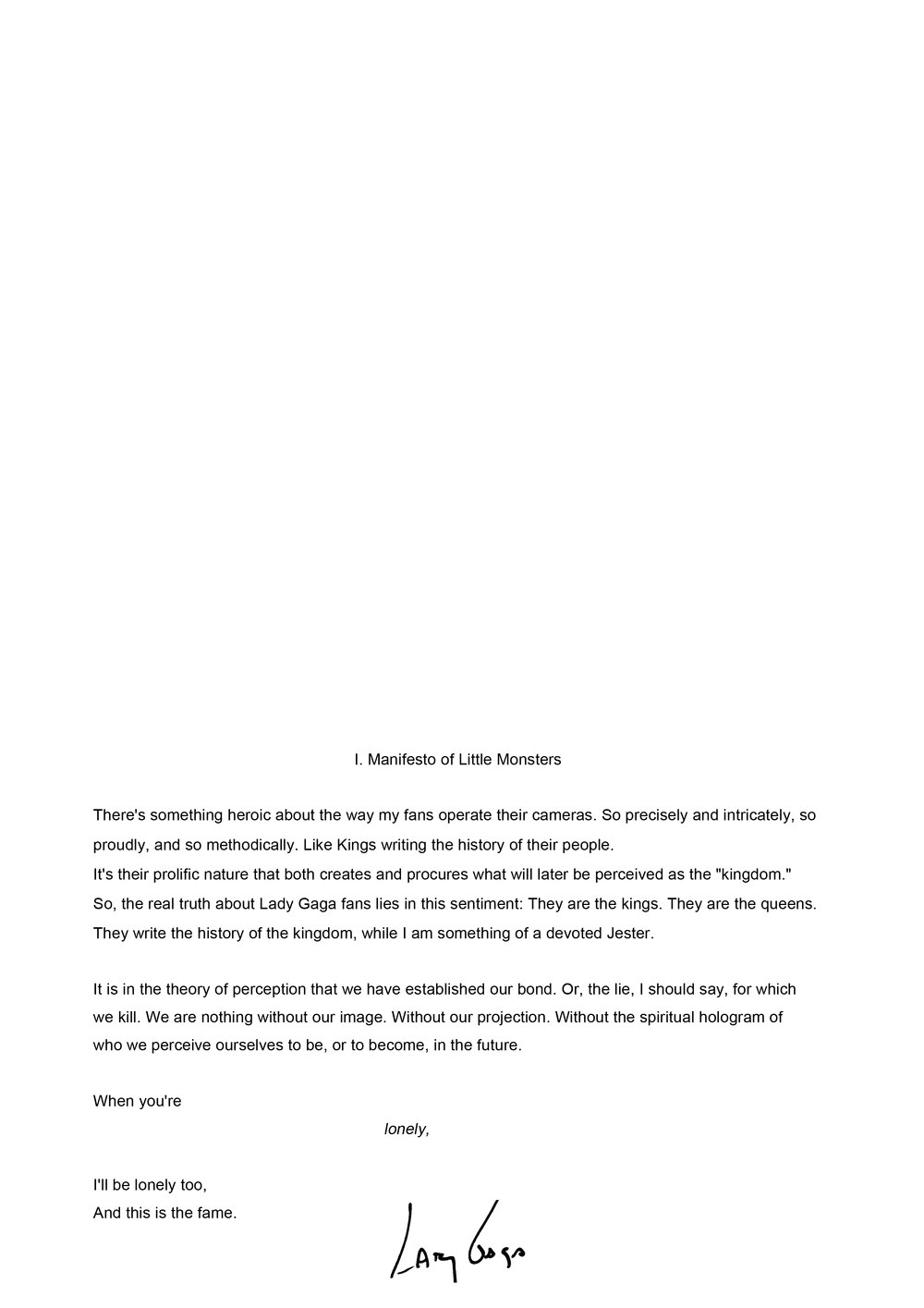
There’s something heroic about the way my fans operate their cameras. So precisely and intricately, so proudly, and so methodically. Like Kings writing the history of their people. It's their prolific nature that both creates and procures what will later be perceived as the “kingdom.” So, the real truth about Lady Gaga fans lies in this sentiment: They are the kings. They are the queens. They write the history of the kingdom, while I am something of a devoted Jester.

With this performance, the Manifesto of Little Monsters becomes all the more literal in its effects on this Pierrot figure, following the terms I enumerated in my essay. However, now the camera-wielding fan is Gaga herself, who becomes a sort of absent center in her own cult – a center that, as the Pierrot image confirms in its ontology, is always missing, and only a product of temporal embodiment through performance. Here, it is Gaga who operates as the fan, while the drag-queens manifest the figure of Gaga through their reduplications of the figure of Pierrot in keeping with the album cover – a figure that Gaga has (like them) also partaken in but is not necessarily intimately connected to. This is to say that here, Gaga is manifested through the drag-queens only through a form of what I’d call oblique signification – the drag-queens stand in for her because they duplicate a form that Gaga herself has taken up through an analogous drag. After all, in dressing as Pierrot she was in male-drag; yet, in dressing up as Pierrot – with Gaga in the room – the drag-queens remain in female drag through the ricocheting signification that is triangulated between their bodies, the Pierrot, and Gaga.


It is therefore not surprising that Gaga released an image of her standing before a number of wigs in conjunction with the unscheduled drop of “Applause.” Here the wigs capture the iterative and permutative quality of Gaga’s image: they are suspended behind her on an aluminum-foil plated bar, while she (presumably) wears a wig from the empty peg. Thus, her appearance in the image is not a finite manifestation, but rather only one permutation on a spectrum of images available to her. 


Note also that the aluminum foil undoubtedly serves as a quiet allusion to Andy Warhol’s 1964-67 Silver Factory on 231 East 47th Street (between Second and Third Avenue), which was decorated in silver paint and aluminum foil. Hence, the image riffs on the history of iterative permutations in art, and on the Warholian Factory analogy that she played with early on in her work.


When Gaga posed for a picture with Shangela, which Shangela shared on her Instagram and Twitter, it is telling that there the two hold together a Styrofoam head, the type that is used as a wig-stand – as in Gaga’s Twitter image. Shangela, looking at the camera, supports the head eagerly with her left hand, while Gaga wraps her left hand around Shangela’s shoulders and nominally holds the head by the neck. Of course, the head is empty; its white, Styrofoam flesh is not a medium for the performance – that, of course, is Shangela. Rather, the Styrofoam head functions as a preparatory condition or sketch, as an image that in a sense prefigures the performance of the white-washed body of the Pierrot on stage. While this head surely could be found in the dressing room of any drag show and need not be related to the performance itself, in this image it suggests that the skull-cap on Shangela’s head – as would a wig – once stood on this mannequin, yet the head is currently empty as the head-piece is in use. Thus, the bareness of the white Styrofoam head blurs with the artificial, caked whiteness of Shangela’s flesh. The Styrofoam head trips the Pierrot system by playing with the white neutrality of the medium and its shape as a topography for additive accouterments, while likewise demonstrating the deep racism of such modernist, medium-oriented whiteness when juxtaposed with Shangela, who is by all means in white-face in the image. Thus, it stresses the artificiality of medium conditions and their deep-seated prejudices – a prejudice that preemptively excludes groups from artistic production and proliferation. Here the joke is turned on that system rooted in myths of sincerity and neutrality to demonstrate just how much makeup is needed to produce the myth of the modernist white-canvas as the Ur-body or Ur-medium of artistic production.

But let us return now to the drag show: in wielding the camera during the show, Gaga disappears as nothing more than a non-dimensional liminal site of generativity, that thin gossamer screen through which images ooze out or on whose surface they are projected. Here, the artist is not present – insofar as we treat this as positivists or as a tabloid that would merely describe this scene with the naïve sincerity of Gaga visiting Micky’s to do nothing more than straightforwardly film her music video. From such a perspective, we see Gaga wielding the camera as a signature of her authorship and so on, but this is not what happened here. As the evening’s host points out while looking at the audience, “They’ve got their iPads out, their iPhones, their Blackberries...” The performance is curated in such a way as to be disseminated in fragments and excerpts throughout YouTube, Vine, Twitter, etc. – Why? Simply because – indeed– the artist is present, or to put it in less pretentious words: because Gaga was there.

Surely, this footage will soon appear as part of Gaga’s (lyric) video for “Applause,” and the video will undoubtedly herald itself as being filmed and directed by Lady Gaga – perhaps in collaboration Inez van Lamsweerde & Vinoodh Matadin. Nevertheless, this performance on the night in which “Applause” was un-ceremonially released should not be forgotten or obscured by whatever order of signification that video presents us with: that is, by how it stages the spectrums of authorship, presence, and signification of Lady Gaga. This performance must not be forgotten because it positions Pierrot and Gaga as absent centers, and demonstrates the possibility for oblique signification that the configuration enables.

There is still however another crucial aspect here that plays into the current campaign for “Applause”: the power and possibility of failure. Has no one yet derisively mentioned that Gaga walking around Los Angeles in Yves Saint-Laurent and Pierrot makeup looks like Heath Ledger’s rendition of the Joker? The makeup of “Applause” seems to preempt – or rather – desireits own insult through a comparison with the iconic character of the Joker. Of course, that’s precisely it: the minute you say that Gaga is going around looking all ratchet and like the “Joker,” you’ve literally called her the “Jester” – the term that she identified with and chose to capitalize in the publication of the Manifesto of Little Monsters.


When I proposed ekphrasis as an operational model for ARTPOP, I was attempting to embrace what was already apparent before “Applause” dropped: namely, Gaga’s play with concepts of failure and faltering – which importantly sets this new work apart from the “It Gets Better” drive of the Born This Way period. It is in this lust for failure that Gaga truly has the potential to excel. Not only because she is acknowledging current opinions about her or her (literal) bodily failure that forced her to take time off, but because it engages with a crucial part of the queerness of Gaga’s work.

In The Queer Art of Failure (2007), J. Jack Halberstam’s begins  this Duke University Press book with a discussion of SpongeBob SquarePants, pointing out that the book’s criticality is surely to be questioned by opening with a popular children’s cartoon. This, of course, goes on to serve as the foundation for Halberstam’s project on the queer art of failure. The move away from seriousness or rigor – terms that enforce normative disciplinary correctness – are at the core of a certain line of contemporary queer theory. This scholarship looks to the queerness of queer – and other post-queer formulations – as a form of engaging alternative bodies of texts and sources, and at the same time risks discrediting itself by not being taken “seriously.” The emancipation and embrace of “low theory,” as Halberstam calls it, allows for a new generative landscape beyond the strictures of disciplines created over a hundred years ago. The Queer Art of Failure engages with subcultures, countercultures, and popular cultures that have been traditionally associated or synonymous with failure. It is in this desire for failure and destructive generation that the myth of the hedonistic queer and the oppressed queer find a common ground, a radical seizing of insult and injury as a reparative tactic. It is within this platform that Gaga has oriented herself, particularly, after releasing the Haus of Gaga video: “Lady Gaga is Over” (cited at the opening of this extended Coda).


While New Now Next, the Huffington Post, and others have cited it as a form of reverse psychology, this video is in fact playing with ideas far more prevalent in contemporary queer theory and art production than is evident to the writers of these blogs. In fact, their responses have actually played in to its self-attested failure with their snide comments, yet in their own naïveté they have failed to see the generative constructions and quasi-utopic potentials of failure as a method – a method upon which the gay community has implicitly strived for decades. Yes, as the video’s transcript makes evident, there is an overall tongue-in-cheek gesture to the clip – and in fact, particularly towards the end it comes close to undoing the crucial potential of its own gesture by saying things like: “STOP THE DRAMA. START THE MUSIC.” However, this paradox emerges from Gaga’s own desire to make a post-critical method as articulate and clear as possible, hoping it’s not too subtle to pass by unnoticed. While I encourage Gaga to embrace failure as a new (post-)critical model and delve into what failure could actually mean for a pop-star of her magnitude and fan-base, the video nevertheless shows the power of utilizing failure as a starting point and as a point of approach. Perhaps, that’s precisely it, even if you hate it, even if it is terrible: stop the bitching, start dancing – and, in our case, start writing.    

Author bio:
Roland Betancourt is a doctoral candidate in the History of Art Department at Yale University writing a dissertation entitled, “The Proleptic Image: An Investigation of the Medium in Byzantium.” In April 2012, he co-chaired a major symposium at Yale entitled Byzantium/Modernism on the mutually generative collision of Byzantium and Modernism. In addition to various other projects, he is currently editing a special volume of the journal postmedieval entitled, “Imagined Encounters: Historiographies for a New World,” which asks scholars to suspend disbelief and create cross-temporal analyses using artworks and theories from different historical spaces.


Click here to follow Gaga Stigmata on Twitter.
Click here to “like” Gaga Stigmata on Facebook.

Compare hotel prices and find the best deal - HotelsCombined.com
Twitter Delicious Facebook Digg Stumbleupon Favorites More