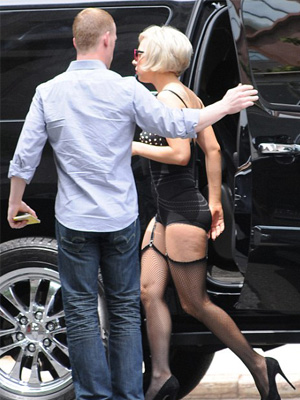
with Kate Durbin, Lesley Kinzel, and Meghan Vicks
Gaga Stigmata has long wanted to respond to a number of articles that approach Lady Gaga from a feminist stance, or that take issue with Gaga’s work and its depictions of gender and sexuality. To this end we invited Lesley Kinzel - fellow Gaga enthusiast, and recently honored as one 40 Feminists under 40 by the Feminist Press of CUNY - to join us for a discussion regarding Gaga’s place in feminism. We took into account a number of recently published articles and talks given by established feminist scholars, including those by Nancy Bauer, Jack Halberstam, and Camille Paglia, and considered articles written on various blogs, in particular one geared toward body acceptance. We look forward to you joining our discussion in the comments.
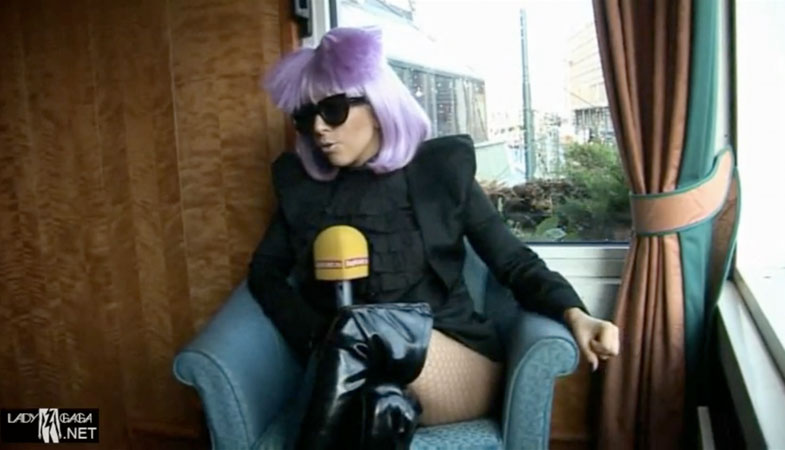
In the now-infamous Norwegian interview, Lady Gaga said, “I’m not a feminist! I love men! I hail men.” Six months later, she praised Ann Powers of the Los Angelas Times for “being a little bit feminist, like I am.” How can we make sense of Gaga’s conflicting self-evaluations regarding her own feminism? Should we?
Lesley Kinzel: The Norwegian interview was actually the first thing that drew my attention to Gaga as possibly being anything other than the standard pop star, mostly because of what she says immediately prior to disavowing feminism:
If I was a guy and I was sitting here with a cigarette in my hand, grabbing my crotch and talking about how I make music because I love fast cars and fucking girls, you'd call me a rock star. But when I do it in my music and in my videos, because I'm a female, because I make pop music, you're judgmental.
Her response to the journalist’s follow-up question about feminism struck me as a knee-jerk reaction to a word and/or identity she doesn’t seem to have given much thought – going directly to the stereotype that feminists hate men – though her prior point could easily qualify as a feminist perspective. The LA Times article was printed six months later, and this may not so much be a conflicting comment as it is evidence of an ongoing evolution in Gaga’s understanding of feminism. She may not like the word, still, but I’d argue she has progressively moved in a more feminist direction in subsequent interviews, and even in her increasingly aggressive persona.
Meghan Vicks: I agree with you, Lesley, that the contexts in which Gaga made these statements shape their implications. I also felt that in the first interview, her statement “I’m not feminist!” was supposed to be sarcastic since it followed some pretty astute remarks about how men and women are judged differently when it comes to sex. It would be as if I, a graduate student of comparative literature, after launching into an impassioned speech about the virtues of Shakespeare or the hilarity of Nabokov, confessed, “Ugh! Literature, I abhor literature!”
So the context of Gaga’s statement during that interview either points to its sarcasm, or to her aversion to the word “feminist” itself - which is not an uncommon aversion, even among those who readily agree with feminist principles. Of course, now we’re tiptoeing along the edge of controversial territory: what does feminism stand for, and why has it become such a negatively charged word in contemporary society? That discussion likely falls outside the scope of this one, but for our present purposes, it behooves us to acknowledge that in Gaga’s generation, many feminist-acting and feminist-thinking individuals are wary of the term “feminist” itself.
I also think her statement “I’m not feminist! I love men! I hail men!” can be placed in the same category as her assertion, “Pop stars should not eat.” These statements are, I think, purposely radical - they are anti-feminist, blindly adoring and worshiping of men, pro-starvation for the sake of an admirable body that fits today’s standards of beauty and sex appeal, even somewhat misogynistic. They are, in other words, statements that today’s contemporary pop star projects. If Gaga is playing the role of the contemporary pop star, then she will make statements like these; and hopefully, if we’re horrified by what we hear, we’ll become a “little bit feminist,” like she tells Ann Powers she is.
Finally, if you watch the full interview, it becomes apparent that Gaga is rejecting a stereotypical version of feminism: that feminists “hate” men. She assumes that the interviewer perceives feminists as men-hating, and so she pushes against that label.
Kate Durbin: What you said, Meghan, about “feminist-thinking individuals” of Gaga’s generation being “wary of the term ‘feminist’ itself” seems particularly relevant to Gaga’s project. She is the self-proclaimed “free bitch,” and her agenda is one that, as Lesley points out, seems to merge ever more directly towards her generation’s particular political needs, as her own image becomes ever more aggressively political. In fact, she claims her new album Born This Way is an anthem of her generation’s deepest desires, and she increasingly sees herself as a spokesperson for and embodiment of these desires, talking repeatedly about “not letting her fans down” and wanting to “be good for [them].”
Gaga at DADT rally in Maine, giving her speech “The Prime Rib of America”
In context of the desire for free individualism, Gaga’s agenda is one that promotes “being yourself.” It’s not always easy to “be yourself” when you are taking on a historically heavy mantle every day (i.e. that of the token “Feminist”). Gaga, like many of her generation (her fans), felt misunderstood and pigeonholed both in school as a kid, and also by the music industry. It seems that when she reacted to the male journalist’s dismissive remark, it was just that – a reaction to being limited as a caricature in a dismissive way, but also because this guy refused to understand, his goal was to put her down. And so she put him in his place. This of course ties in neatly to Meghan’s work on Gaga as Trickster of Pop Culture, how Gaga reflects/mimics those she comes in contact with. She can demure (Barbara Walters) or fight (Asshole Male Journalist) with the best and the worst of them.
As was pointed out, Gaga later revised her stance on feminism, as she is constantly revising herself as her identity fluctuates in this technological, post-post modern age, just as her fans’ identities are also constantly flickering. Sure, she is a little bit feminist. She is also a little bit of a whole lot of other things too, depending on the day, the performance, and what attributes of her fans she is channeling/embodying in an almost Catholic, martyr-like way.
Putting aside what Lady Gaga says about her own feminism, how does her music and performance deal with or speak to issues of gender and identity politics, if at all?
Meghan Vicks: Gaga wields the phallus (her disco stick in “Love Game,” alter-ego Jo Calderone, strap-on and/or rumored dick, her and Beyonce’s plastic cartoon-like guns in Videophone, gun bra in Alejandro) often with tragic and comic results, or to turn the phallus on its head. She undermines the male gaze, performs a multitude of genders, destabilizes traditional gender categories (or maybe even works to move beyond gender), advocates safe sex, and fights for gay rights. She exemplifies a version of a mother that is proud, powerful, and monstrous. All these have been, at various times and in various ways, feminist projects.
Gaga commands the phallus; those men are drawn to her disco stick.
Most of all, (and this is really where I find her feminism, although it might not look like feminism at all), she controls her identity, gives birth to her own identity. I mean this to imply something much more complicated than just creating identity; the term “birthing identity” comes closer to what I have in mind, as it indicates a kind of oxymoron - both natural and constructed simultaneously.
For Lady Gaga performs an identity that is quite paradoxical. On the one hand, her identity is performance, costume, acting, poses, and lies - all these non-essentialist, non-foundationalist, non-immanent modes of identity. On the other hand, her identity is fated, true, “born that way,” and real - that is, essential, foundational, and immanent identity. How can one be simultaneously “born this way” and a stage act? Both the lie and the truth? Gaga is the lie that was “born this way.” Her own statements in various interviews, as well as her music and performance, speak to this paradox.
So what does this have to do with feminism, or issues of gender and identity politics? For one, it puts performative identity in the space of essential identity, thereby at once giving freedom to identity (you’re free to be who you want to be) and legitimacy to identity (it’s true, cause it’s the way you are). Lady Gaga embodies an autonomous identity that is at once created through her own desires and wants, and always already born that way, preexisting those desires in a sense. Her creation of her identity becomes how she was born. And this, I feel, can be a powerfully feminist stance and tool - a method for creating autonomous identities, a method that releases identities from both cultural and essentialist dictates, and conversely empowers one to determine their own created/natural identities.
Kate Durbin: It’s important to note as well that Gaga has, unlike other pop stars, ceremoniously embraced the role of “role model” for young kids. To me, this is one of her most feminist gestures in that she clearly sees herself, as you pointed out Meghan, as a sort of mother-figure, but also as an activist figure. She sends messages to parents of her fans where she claims “your kids are safe with me.” As an activist, Gaga has openly spoken out against homophobia and misogyny in the music business; in fact she ties the two together in such a way that feels very close to third-wave activism of the last couple of decades, a movement that has been as invested in gay rights as women’s rights. And she has encouraged her fans to become active as well - she is, in her mother-marytrdom, very focused on her fans cultivating relationships with one another and feeling “liberated” (the monster ball has been described over and over by Gaga as being about liberation) in their own power, instead of blindly worshipping her. Case in point: a recent tweet from Gaga: "It is through reciprocal loyalty and dedication that vision becomes Justice; Justice for the nerds, the disenfranchised, + the insecure." Pretty radical for a pop star!
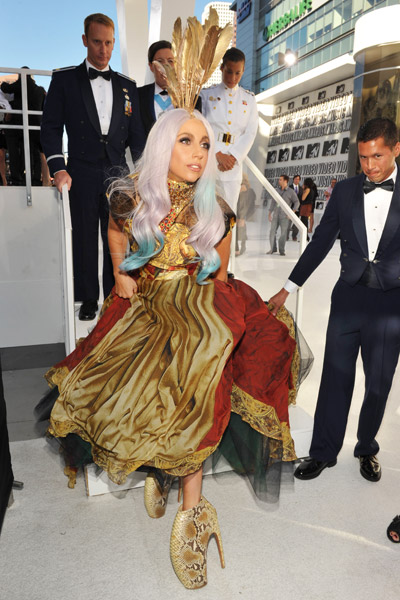
Gaga also, of course, incorporates highly political gestures into her performances. For example, her first VMA performance read very much like a feminist performance art piece along the lines of the female body artists such as Vanessa Beecroft, Hannah Wilke, or Carolee Schneemann, and her second one - with the four discharged service persons as well as the meat dress - also read very feminist and queer activist. Gaga has even gotten involved in politics directly, speaking at a number of rallies against DADT, and becoming a spokesperson for MAC’s Viva Glam Aids Fund along with Cyndi Lauper.
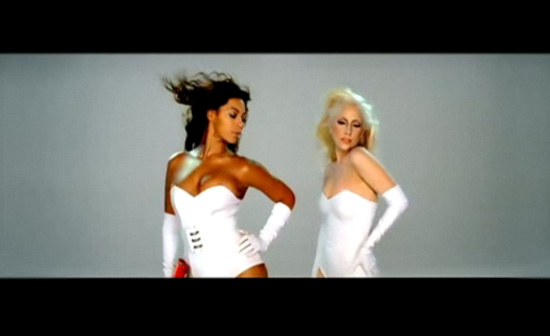
Thus the tradition of feminist activism, as well as female partnerships, is very strong in her project. Gaga has spoken out against the pitting of female artists against one another, and her collaborations with Beyonce are examples of how Gaga actively works against the notion of women as cutthroat competitors in the music industry. Gaga has said that she wanted the Telephone video to be more about Beyonce than about her, and when she collaborated on Beyonce’s Videophone video, she said she wanted to honor Beyonce by dressing like her. She called herself Beyonce’s “fly girl.”
Beyonce with Gaga as fly girl in Videophone
Beyond these more traditional examples of Gaga’s feminist gestures, though, I do think Gaga problematizes traditional feminist criticisms. The way Gaga destabilizes gender identity generally is the real root of her danger. She is a threat to feminism in that her ultimate goal is to render it unnecessary, in favor of a larger global shift toward polymorphous gender and sexual identities. And so anyone who is bound up (and yes, feminism can be very binding) in ideals that truck in identifying proudly as a man or a woman (whether gay or straight, fat or thin, black or white, etc.) and promoting the rights of their “group,” well, they will feel threatened by a project such as Gaga’s, which promotes a new kind of group - a group of monsters - not entrenched in such old-fashioned binaries and identifiers. As, perhaps, they should be threatened.
Lesley Kinzel: Amongst Gaga’s plentiful efforts at unsteadying gender, my favorite moment continues to be the outstanding crotch-shot of Telephone, as I think it beautifully illustrates Gaga’s playful relationship with gender norms and expectations.
I originally described this scene on my blog:
Gaga... jumps up and angrily grabs at the bars, climbing to hang from them with her head out of the frame and her legs spread, while the guards walk away saying to each other, “I told you she didn't have a dick.” “Too bad.” This, of course, is an in-joke, a reference to the much-ballyhooed rumors that Lady Gaga is intersexed, rumors she often seems entirely too amused by to fully discredit. If Gaga had any real anxiety about her penis rumors, she’s had multiple opportunities to address them before now. Instead she seems to have chosen to both dismiss and fan the flames at the same time.
And so it comes to pass that in the first minute... Gaga is literally shoving her blurred-out, fishnet-clad snatch in our faces, in what functions as a comment on our communal sense of entitlement to the most private aspects of the lives of those we elevate to the heights of fame. As a culture, we fancy that even the genitalia of our stars is our business, and we’re most interested in that (as in anything) when we think they’ve got something to hide. But the most sublime aspect of this presentation is the digital blurring. The image is a huge tease that ultimately tells us nothing. There could be a vag there, sure, or there could be the fabled “little bit of a penis,” or she could be smooth and slit-free as a Barbie doll. Gaga’s crotch shot says: is this what you want, a look around a woman’s body that is literally incarcerated, the freedom to explore her like she’s nothing more than a doll? Well, fuck you. Some information is still not public property. Some privates, it seems, are still private. Too bad.
I was surprised, as other analyses of the video poured in, to find that many viewers saw this in totally different terms - the common take seemed to be that Gaga was attempting to prove wrong those who were accusing her of not being entirely female, and when combined with the casting of female bodybuilders in the roles of prison guards, some viewers read the entire event as overtly transphobic. The problem is, Gaga was never rumored to be transgender, but rather the rumors were that she is intersexed, which muddies the waters a bit. Given that intersexed bodies can often defy culturally-comfortable gender binaries even with a non-blurred look at their business, the suggestion that Gaga is neither male nor female - even if you can perform a close-up examination! - creates a persona that is even more sexually confounding/challenging.
Gaga herself has said:
I love the rumor that I have a penis. I’m fascinated by it. In fact, it makes me love my fans even more that this rumor is in the world because 17,000 of them come to an arena every night and they don’t care if I’m a man, a woman, a hermaphrodite, gay, straight, transgendered, or transsexual. They don’t care! They are there for the music and the freedom. This has been the greatest accomplishment of my life - to get young people to throw away what society has taught them is wrong. Gay culture is at the very essence of who I am and I will fight for women and for the gay community until I die. (Source)
I think all this fits neatly with Kate’s assertion above, that “[Gaga] is a threat to feminism in that her ultimate goal is to render it unnecessary, in favor of a larger global shift toward polymorphous gender and sexual identities.” Gaga reliably drives critical conversation about gender as an identity and as a reality not as easily pinned down as we’d like to believe, building discussion even amongst people who are mostly interested in her as an allegedly-vapid pop star. If there is not yet such a thing as postgender, Gaga may be a harbinger of it.
Does Lady Gaga express strength as a woman, or self-objectification? Are the two mutually exclusive?
Meghan Vicks: Lady Gaga certainly performs self-objectification. Whether or not she expresses strength as a woman is more difficult for me to determine. As I see it, she embodies strength through her self-objectification - but is that strength intimately tied to her femininity or womanhood? I’m not sure. It’s a strength tied to her person and performance - but that person and performance is constantly complicating and blurring categories of gender. I guess, I sometimes wonder whether or not Lady Gaga is performing as a gendered woman at all, or is she rather performing as a being that’s beyond gender - both masculine and feminine at once, and neither masculine nor feminine, and everything in between and beyond.
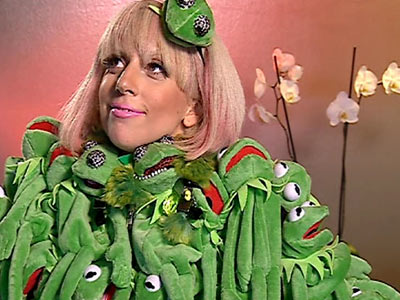
I mean, how do you categorize (gender-wise) Lady Gaga in her Kermit the Frog dress? (And, for our biology-in-the-know readers, I should point out that some frogs can change sex! - to complicate our matter even further).
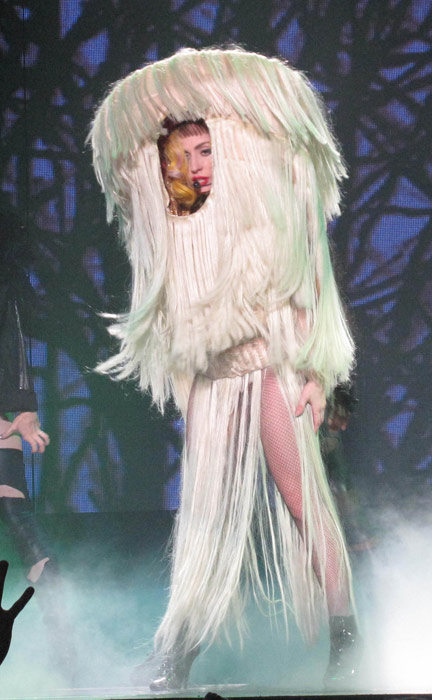
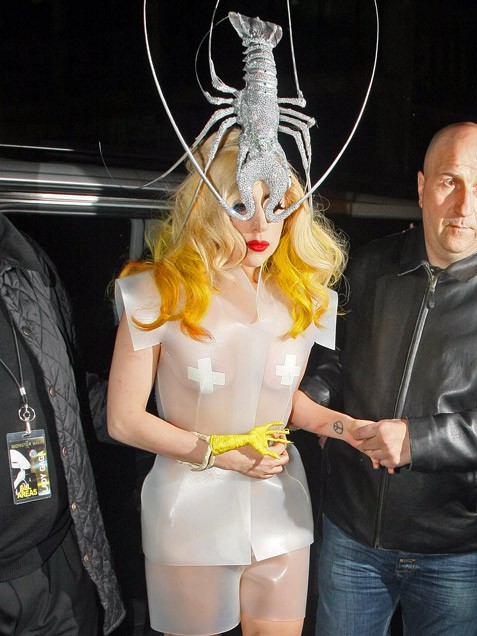
What do you make of Gaga’s gender when she shows up looking like this?
Or this:
But let me go back a few steps.
Does Gaga turn herself into an object of the sexual desire of others? Yes. Does she market herself as a commodity to be capitalistically consumed? Yes. Does she perform as a slave owned by others? Yes. She certainly turns herself into an object, but here’s the kicker: she never relinquishes her autonomy. And another kicker: oftentimes, the object she turns herself into subverts the subject’s desires. She’s an (oxymoronic?!) autonomous object!
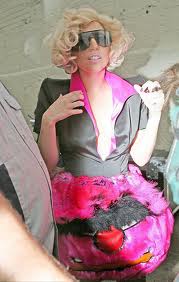
You know how the paparazzi are always trying to get the million-dollar up-skirt shots of female celebrities? (And I love your discussion, Lesley, of Gaga’s crotch shot in Telephone ... Maybe we should make another discussion in which we just write about the metamorphoses and statements that Gaga’s crotch has made!) Well, check out Gaga:
When I saw this photo, I thought Gaga’s giving them her up-skirt, quite literally! Hasn’t she also turned her nether regions into a big, pink, uni-broweed, hairy monster! Or, another example:
In the above photo shoot for Rolling Stone, Gaga embodies many signifiers of a sex object: feminine curves, blond, doll-like, naked. But her curves are hyperbolic and somewhat disconcerting, and the plastic bubbles make her look misshapen and tumor-ridden, and then there’s the dead or passed-out or climaxed-out or orgasm-riding bodies surrounding her. It’s a scene of a sex orgy, and Gaga’s definitely a sex object (maybe even the phallus: she is the only upright figure), but it’s an orgy and an object that are a bit (or a lot) off-putting. I’ll usher out America’s stereotypical, main-stream, culturally-determined, heterosexual, white, middle-class, average-weight Straw Man: you wanna join this orgy, Mr. Straw Man? Not in a million years, he says as he carefully backs away.
So yeah, Gaga turns herself into an object, but often renders that object monstrous, or even grants that object a subjectivity of its own. And she therefore exhibits strength and power via her self-objectification. But Lady Gaga’s strength and power aren’t necessarily tied up with womanhood. She is a being whose gender is so other-than, so beyond our typical categories of masculine and feminine, that I just can’t say she’s exhibiting strength as a woman. She is an incredibly powerful woman, but her strength is not simply an expression of her being one.
This is quite different from Madonna, who performs strength always as a woman. In the sense that, you can’t divorce Madonna’s performance from her womanhood. I mean, it is thrilling and empowering to watch Madonna, decked out in a man’s suit, dance and aggressively grab her crotch in the video Express Yourself - but a lot of the thrill comes from that fact that she’s a woman who usurps the position of a man. Come on girls! Do you believe in love? ‘Cause I got something to about it. ... Do you know what it feels like in this world for a girl? ... Express yourself don’t repress yourself. Would it sound better if I were a man? You’re the one with the problem. ... Papa don’t preach. ... I can make it alone, my sisters and me.
Madonna is a woman who has taken up the space traditionally belonging to men, and she’s claiming that space for women as well. On the whole, Madonna’s project has been about the spectacle of being a woman, the expression of feminine power, the reclaiming of sexuality for women. This is not what Lady Gaga does.
Lesley Kinzel: I love the inevitable comparisons of Gaga and Madonna (the yardstick by which all female pop stars are measured), because while it’s true that without Madonna, Lady Gaga would assuredly not exist, it is reductive to argue that Gaga does nothing that Madonna hasn’t done before (for one, I never recall Madonna wearing plush toys, though I may have missed that particular photo shoot).
I agree, Meghan, that what Gaga does differs in some critical ways. Madonna has historically exploited our notions of traditional beauty and femininity by performing an over-the-top model of female sexuality. Madonna does this with a wink and a nod, but ultimately she is reproducing the female body as sexual object. Madonna’s use of drag in the Express Yourself video (from which the still image above is taken) evokes not so much true gender fuckery as it does the absent man whose clothes she’s borrowed. Madonna’s performance can be read as critical, certainly, but it can also just as easily be read as underscoring the status quo. She is often a mannequin on which various characters - ingenue, bitch, hapless maiden - are drawn.
Gaga, on the other hand, is her own object and as such defies the archetypes on which Madonna’s performance relies. Gaga’s ingenue goes to prison in Telephone, and her hapless maiden kills the man who purchases her body at auction in Bad Romance. By melding objectification with action and/or violence, Gaga forcibly controls her circumstances, even after being thrown from a balcony by her faithless lover (Paparazzi). As an object also capable of unpredictable violence, Gaga can depict such gendered expectations without being pinned down by them.
It really surprises me that people get so hung up on Gaga’s sexuality - her violence is far more fascinating to me.
Meghan Vicks: Omg me too! We’ll have to talk about Gaga’s violence at a later date! ;)
Jack Halberstam has said, in Telephone’s “brave new world of Gaga girliness, we are watching something like the future of feminism. [...] What one wants to inspire is new work that one barely recognizes as feminism, and that’s what I’m going to call Gaga feminism. [...] Instead of becoming women, we should be unbecoming women - that category itself seems vexed and problematic.” Reactions and/or thoughts?
Meghan Vicks: As I talked about above, when I watch Gaga, I feel as though I’m watching a performance that so complicates and renders ambiguous traditional categories of gender that I can’t say Lady Gaga is performing as a woman. In this respect, I think Gaga heralds a kind of future of feminism, as Halberstam suggests.
But then I think: hasn’t this been done before? Haven’t many performers complicated categories of gender? For instance, how is what drag queens do different from what Gaga does? Drag queens certainly problematize fixed conceptions of gender, and display how all genders are create via performance. And besides drag queens, there are countless gender and sex performance artists whose work deeply complicates perceptions of gender.
However, I think Lady Gaga performs gender in a way that not only complicates its categories, but makes them completely irrelevant. Almost as if she does not want to be gendered at all. This is her performance: a being that refuses to be distinguished by gender. Her performance presents a gendered body that not only exhibits the split between biological sex and culturally-constructed gender, but moreover thwarts attempts to be controlled or defined by gender. She’ll perform an angelic feminine one minute, a trampy vixen the next, and a day later she appears on a magazine cover as Jo Calderone - but never do these genders determine who Lady Gaga is (and this is probably why she performs so many different gendered beings, but also beings that can’t necessarily be gendered - robotic, monstrous, abject, cyborgian, alien). I think she’s after a kind of identity that isn’t categorized according to gender: a post-gender body.
So this is what I think Halberstam is getting at when she talks about Gaga ushering in a new kind of feminism that “unbecomes women,” that goes beyond the category of woman.
I guess we should also ask why more socially-active feminists would want to go beyond the category of woman, and how a feminism “that barely looks like feminism” would be a useful (if at all) political and social tool for progressive change in the political and social spheres. Because Gaga certainly envisions at least one of her roles to be a vehicle for political and social change. Her HIV/AIDS activism, as well as her work to repeal DADT, both figure her as a social activist who uses her persona to promote her cause.
Kate Durbin: Agreed! Gaga pushes beyond the categories of woman or man or even human to that of the post-human. As Donna Haraway says, “the posthuman is not a singular, defined individual, but rather one who can ‘become’ or embody different identities and understand the world from multiple, heterogeneous perspectives.” This relates not only to what Gaga does with gender in her videos and performances or on the street, but it even ties back to her mystical union with her fans - how she sees herself as a flickering screen of their desires and needs. To totally freak Walt Whitman, “Gaga is large, she contains multitudes.”
In other words, Gaga does not just speak for her fans, she is them.
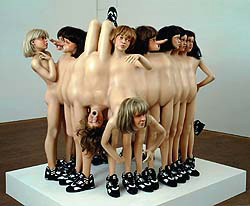
A sculpture by shock artists Jake and Dinos Chapman
Which is why I feel that Gaga is writing her own speculative fiction in a sense, with her project, something along the lines of an Ursula LeGuin novel. Le Guin’s characters have mutated beyond one fixed gender but the concerns of her texts are inherently feminist, in that they are imminently concerned with the future of living beings and this planet we call our home. This, to me, seems to be the future of feminism - something larger than just gender rights. It might be interesting to see if Gaga incorporates more of an environmentally-focused feminism into her art/activism of the future. Her new album Born This Way already speaks to issues of biological determinism in its very title.
Gaga is the sci-fi lie that will become the truth. Perhaps she will become the next L. Ron Hubbard, and can save Katie Holmes from Tom Cruise?
Lesley Kinzel: I agree with all of the above, and want to add that “becoming women” is often both limiting (to the individuals who participate in the effort) and limited (to certain people who have bodies incapable of following through on the task). Bodies not biologically sexed as female, bodies that are disabled, bodies that are fat or ugly or simply ill-shaped to represent cultural femininity, all of these are bodies (and people) stuck climbing up the down escalator to womany success. Gaga has played with all these limiting factors - and outer limits - at one time or another, creating, as you have both noted above, a gender that is fluid and changeable and dependent on the outfit, circumstances, or possibly the time of day.
Gaga’s performance as a whole, for me, argues in favor of undoing the very notion of female “power” by undoing not the systems and institutions that dispense that power, as feminism has traditionally sought to do, but by undoing gender itself as a static category. In this respect, I think “unbecoming women” is a good definition of what Gaga does, and a pretty solid feminist approach.
Meghan Vicks: Beautifully put, Lesley.
I also wonder what a beyond-gender society would look like. Because one of the problems with gender is that it is often the first thing we notice about a person: whether that person is a man or a woman, and then how well they fit the corresponding role; that is, to what extent do they “become man” or “become woman.” And the problem with “becoming man” or “becoming woman,” as Lesley so gracefully points out, is that many fail to adequately fill the role – too fat or muscle-ly or tall or masculine to be a woman, too fat or waifish or short or feminine to be a man.
But (cuing John Lennon) imagine if we looked at a person, and we didn’t immediately identify them according to a gender category that carries with it overwhelming cultural baggage, expectations, and assumptions. I think this is the type of identity that Lady Gaga repeatedly performs – one that continuously sidesteps and subverts any and all gender classification. The hope is, I think, that we eventually give up trying to classify Gaga’s gender: not only is it a fool’s errand, but it really does not, and should not, matter.
Writes Nancy Bauer, “Since Gaga herself literally embodies the norms that she claims to be putting pressure on (she’s pretty, she’s thin, she’s well-proportioned), the message, even when it comes through, is not exactly stable. It’s easy to construe Gaga as suggesting that frank self-objectification is a form of real power.” - NY Times Opinionator. Reactions and/or thoughts?
Kate Durbin: Is Gaga “pretty”? I mean compared to Katy Perry, or Rihanna, or Britney, is she pretty? It’s funny because I hear the opposite, often, from younger people - they think Gaga has a big nose or that she looks weird, especially because of how she dresses.
This statement goes back to this idea of “natural” beauty, which Gaga most certainly does not embody except to make meta and therefore implode the image. She also counters this image with her costumes every day. The “natural” beauty of pop stars is an illusion, a culturally constructed and upheld lie that we buy into culturally. Gaga counters this lie all the time with her own lie - a vision of the future that is much more sci-fi and polysexual and post-human. She talks about how she wants to change our view of what is sexy, and how she and her Haus choose costumes that they think are “beautiful” and not simply “kooky.” Gaga has described her performance at the Brit Awards by saying: “I wanted to do a very, very forward performance, something I felt that was a true representation of the future.” It’s important to note their continued insistence on beauty, which is a much broader and less historically gendered term than prettiness. Umberto Eco’s book History of Beauty comes to mind. That text draws attention to the fact that what is beautiful is is totally malleable throughout time, and often contains that which was previously considered as ugly...or, at times, even contains within in that which we currently view as ugly. It seems Gaga and her Haus are constantly pushing these boundaries and borders, with their future-driven vision.
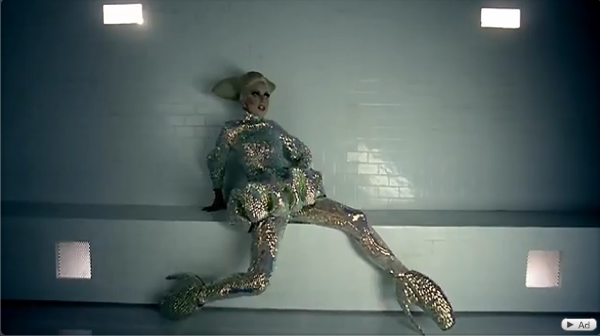
Gaga as a beautiful futuristic lizard in the Bath Haus of Gaga (Bad Romance video)
I wonder what Gaga would need to look like to convince Ms. Bauer that she was not self-objectifying? Or that her self-objectification was part of her project? She was ridiculed in high school and called “fat.” Would she need to gain a significant amount of flesh now? Because she already warps her “prettiness” and “thinness” and especially her supposed “well-proportions” by obscuring her face and wearing costumes like these:
This is a more subtle, day wear version of Gaga, but check out those hips! Definitely not “thin!”
Here is a stage version. Last time I checked it wasn’t sexy to be covered in [body] hair. Can you imagine Spears doing this? Or even Rihanna? [And, I should add, Gaga’s legs do not look stick-thin here - she looks healthy and ready to rock it].
I love this image of Gaga evoking Leigh Bowery’s pregnant belly costumes - not only is Gaga subverting the notion that a flat belly is desirable, but pregnancy itself is something that can be costumed and paraded at will, by those of either gender. Mother Monster, anyone?
Again, I’m not sure what Gaga could do to assuage Bauer besides actively trying to gain weight, to try and turn herself into a Beth Ditto figure. Beth Ditto is gorgeous and preaches that it’s good to parade your own flesh, no matter what your size. And that is how both these women preach similar messages: “it’s more than okay to be who you are.” But, for Gaga, fashion is flesh. Who you are is malleable from day to day. Through wigs, through fashion that obfuscates and warps the body. The possibilities are beautiful.
Meghan Vicks: I think Bauer’s qualms concerning Lady Gaga’s self-objectification are legitimate: she’s worried that Gaga (and, by proxy, women) too heavily derive power from being objects - that when one utilizes self-objectification to control and claim power, one still only gains power as an object and not as a subject. As such, one’s still not free. To put it another way, can Lady Gaga (and women) be powerful subjects, or are they only powerful as objects?
It’s a good hesitation, and Bauer is right to make it. However, I don’t think that Lady Gaga’s self-objectification so neatly reduces to becoming a desired object in order to wield power over the desiring subject. For one thing, the object Lady Gaga becomes is often undesirable - is an undesirable object that wields power over its subject still an object? I’m tempted to launch into a mess of jargony gobbledy goop, but I’ll hold back for now. Instead, I’ll just say this: does Lady Gaga’s performance exhibit a strict subject/object binary at all? Because wouldn’t it need to if it does, as Bauer suggests, turn Lady Gaga into a powerful object by virtue of her control of our (the subjects’) desires? I don’t think that there are clear distinctions between subject and object in Gaga’s performance; it’s more abject, if anything.
Also, Kate - the points you make about Gaga’s prettiness are spot on. I would add: why can’t Gaga be traditionally beautiful and still attack and make problematic conceptions of beauty? Is this only a project for the ugly?
Lesley Kinzel: I would also take issue with “well-proportioned.” Gaga is slender, certainly, and has received a some disdain for her comment that “pop stars shouldn’t eat” - but she is also small-busted in an industry in which implants are the norm. As a result, her barely-clad body, without oversized breasts and with soft flesh apparent, looking unlike the strictly-toned and top-heavy standard shape to which we are all accustomed and which we rarely truly see anymore, seems extra-vulnerable in its failure to be perfect, and in Gaga’s apparent willingness to display it without shame. That said, I agree we rarely get to see Gaga’s actual shape, as she so often obscures it with exaggerated fashion or with computer manipulation, as in the video Bad Romance.
The Beth Ditto comparison is apt, but for a very different reason. Whereas Gaga reshapes and obscures her (mostly) acceptable body shape into something monstrous and grotesque, Ditto strives to show hers off exactly as it really is - monstrous in its natural state so far as beauty standards go - without adherence to fashion “rules” set in place to enable those who see her to be more comfortable with her fatness. Beth’s fat is front and center where Gaga’s slenderness is fuzzy-edged; both women are advocating a revolution of the feminine body from opposite directions.
The argument: Women are still rewarded for pleasing men; Gaga’s power comes from turning herself into what men want.
Kate Durbin: This read seems way too simple for our Gaga. If someone were to state this to me, I would counter with a few questions. Do men, or to be more specifically, do masculinists want bubble dresses? Do they want crime scene taped bodies? Are they turned on by razor blade or cigarette sunglasses? Do they want to be scorched by fire bras or shot down with gun bras?
When Gaga first wore her fire bra at the Much Music Awards, she explained her costume by saying that her breasts were seen as a weapon, therefore she was going to literally turn them into that. Gaga turns herself into what men want, or more specifically what masculinists believe her to be. That’s what the gun bra, fire bra, and meat dress were all about. Masculinists see but a piece of meat, so Gaga gives them exactly what they “see” - a piece of meat. In order, of course, that the Male Gaze might “see” itself. Did anyone else notice that Gaga’s tasty ass hung out of her meat dress? Not a fashion roadkill moment, methinks, but rather a direct reference to the ravenous attention over panty-flashing Britney and Lindsey, etc. Not to mention a gleeful, teenage, mooning-the-authorities moment!
So yes, Gaga’s turning herself into what men want does give her power - but not power over men in the way a woman in a scantily clad dress might get a guy to buy her a drink at a bar. Gaga’s fire bra wields real power in that with it she actually blows up the Male Gaze!
Gaga is no Monica Lewinsky, that’s for sure!
Laura Mulvey explains the Male Gaze thus: “The determining male gaze projects its phantasy on to the female form which is styled accordingly. In their traditional exhibitionist role women are simultaneously looked at and displayed, with their appearance coded for strong visual and erotic impact so that they can be said to connote to-be-looked-at-ness. Woman displayed as sexual object is the leit-motif of erotic spectacle: from pin-ups to striptease, from Zeigfeld to Busby Berkeley, she holds the look, plays to and signifies male desire.”
Gaga is doing more than just exploding the Male Gaze, though. Gaga also toys with Homosexual Gaze in interesting ways. Meghan and Eddie McCaffray talked in their great breakdown of the Alejandro video about how, although Gaga is writhing around with men on a bed in this video, it’s all a pose. The men are all clearly gay. There will be no [traditional] consummation of the sex act, and so we are left with our own frustrated libidos, our screen surrogates therefore failing in their fetishistic representations of any “straight” forward sexualities. And so we are forced to look at ourselves, really look, at what it is we expect our surrogates to do for us, what we expect them to confirm about ourselves.
Gaga and her gay partner in the Alejandro video
I am also thinking of course of the Telephone video, of the women’s prison yard, of Gaga kissing that hot, body-building butch Heather Cassils, about how Gaga’s goal was to celebrate her lesbian friends (and, I would assume, celebrate her own bi-sexuality). And yet there is here a certain stereotypical lesbian fantasy, perhaps even a level of objectification of Cassils, who plays no major role in the video. But because lesbian fantasies in particular have so little air time in contemporary pop culture, this could be seen as a radical and important first start - flaunting what is usually seen as non-sexy by the wider, homophobic, and even more lesbian-phobic audience. And yet we also have to realize that something men want - to go back to the original question about Gaga turning herself into what men want - is for two hot women to make out. This seems, at first glance, to be a classic, straight while male fantasy. But only if those are straight, white, femme women making out. Because straight white masculinists feel super threatened by hot butch women making out with “their” femme partners. So in that way Gaga is yet again sticking it - and I do mean sticking it - to the Male Gaze.
Gaga making out with Cassils in the Telephone video - straight and gay women across the world got wet watching this!
Lastly, I want to add that Gaga subverts the Male Gaze and the Homosexual Gaze by becoming male, in her performance as Jo Calderone. This photo below is fascinating because it plays into the gender stereotype of masculinity - the heading “Homeboys Don’t Smile” is telling. Gaga is playing with butch culture here, and also showing us that gender along with its various expectational baggage is something we can don and subvert at the same time. But the awareness of the Gaze - that we are being watched, and judged- is always present in some capacity in all that Gaga does.
Meghan Vicks: I would also add that Gaga does not buy into the stereotype that men are rendered powerless by a desirable object, which is really, in my mind, an insulting idea about men that still carries too much credence. What you say, Kate, about Gaga subverting the Male Gaze by forcing it to “see itself,” leads me to think that such a project not only problematizes the desires of the Male Gaze, but moreover works to free men from the overwrought stereotypes that the Male Gaze implies about them - that they are driven completely by their libidos, as if their dicks point and their minds hypnotically and without-thought follow, or that we can simply put before them a decked-out pin-up girl and they’ll melt into mush. Doesn’t the Male Gaze ironically indicate that men are bent-over slaves, mere peons of the yearnings of their little-godlike phalluses and idolized balls?
Kate Durbin: This is a great point, Meghan. After all, Gaga’s sheer popularity points to the fact that culturally we’ve already moved past such a narrow view of male sexual desire in practical terms (if male sexuality ever really looked like that anyway, practically, which I doubt). Though we haven’t moved past it in terms of our dangerously entrenched cultural belief system. This is also why I specified masculinists as opposed to men, because men are as varied as women in their sexual proclivities. Also, many women can unfortunately be masculinists, buying into certain cultural beliefs about how they should look in order to please men, becoming gruesome caricatures in their pursuit of the perfect rendering of the masculinist vision. I think Heidi Montag from the MTV reality show The Hills, with her excessive plastic surgeries, is a sad example of this.
The argument: Lady Gaga’s fashion choices are a dangerous model for young girls and feminism. “I am not laying the blame at your weirdly attired feet Gaga, but, your get up got me thinking about how can we expect young girls to value themselves and their qualities when their daily exposure and consumption is about seeing sex sell, be cool and the way to get ahead? It is frightening just how many steps back are being taken in women being treated as equals. And it’s not men pushing us back but other women who feel the need to use sex to get ahead!” - Snezna, We Are The Real Deal
Lesley Kinzel: I find Gaga’s sartorial choices less problematic for young girls than those of your Christina Aguileras and your Britney Spearses, mostly because Gaga is far less overtly marketed to that group. I’d argue these Gaga-contemporaries are a greater danger - and influence - by candidly selling to that demographic while simultaneously portraying adult concepts of sexiness, thereby representing almost a how-to for young girls in precocious sexuality. Both Britney and Christina began in the entertainment industry as child stars, and this is part of their appeal for both kids and adults; we’ve been able to watch them lose their innocence, which holds voyeuristic pleasure for adults, and a model to follow for young girls.
We’ve never seen Gaga as innocent or childlike; her persona sprung fully adult and fully formed from the ether. This is not to suggest that Gaga doesn’t appeal to young girls, or that she doesn’t deal in sex, but that her approach is more advanced. Gaga is strange and complex and even subversive where Britney and Christina were blank slates on which an audience could project its expectations and desires. Gaga’s fashion is expressive and unexpected at the very least, and it’s difficult to make a case that she is underscoring the bland concept that “sex sells” so much as she is interrogating it.
I may be alone in this, but I am inclined to think that if Gaga is teaching anything, teaching young girls to be subversive is not a bad idea.
Kate Durbin: I would seriously love to see little girls wearing fire bras and razor blade sunglasses to school. How awesome would that be? It makes me want to have a little girl so she can dress like that. And a little boy too, for that matter. Little little monsters. No one would eff with them.
Meghan Vicks: You know what pisses me off? Judgments about women’s bodies, and policing of women’s clothing, all in the name of feminism. I really fucking hate statements like the one above, which was published, by the way, on a supposedly body-acceptance website.
I get it. America is afraid of sex (but not violence!). Feminists have fought for years to emancipate women from a pernicious and culturally-entrenched sexual objectification, that renders women the mere playthings and objects owned and controlled by male desire. But it makes me really nervous when feminists, in the name of feminism, try to own and control women’s bodies just like the patriarchal culture they are trying to undermine.
I realize, for instance, that women who wear the burqa or the veil are wearing garments that signify a lifestyle that is controlled by men, but is it any better for Western feminists to claim they “know better” than those who wear the burqa? There’s a battle taking place, and it’s always taking place on women’s bodies. And I realize that when Lady Gaga shows up for a baseball game in her underwear, when she dresses to project a sexual being, or when she wants to ride your disco stick on a subway train, she embodies a sexual object. But when you “know better” than Lady Gaga, when you want her to cover up, (or those wearing the burqa to uncover), you’re controlling her body (and theirs) - you’re objectifying women.
Stop making women’s bodies the battlegrounds for these issues. Stop politicizing women’s bodies.
And another thing: don’t we have the right to be sexual beings, and to enjoy being sexual beings? Even if Gaga did not turn herself into a monstrous desired object, if, for instance, she performed a one-dimensional sexuality a la Britney Spears or Katy Perry, I would still defend her right to parade around in her panties, to glorify in her sexuality, and not be blacklisted as a whore, not be labeled a detriment to our straw-children, and not be reduced her sexuality.
Ok, I’m putting my soapbox away.
Kate Durbin: Preach it, Meghan! I could not agree more. This makes me think of the recent Gaga-esque performance of two French women in protest of the recent burqa ban by wearing burqas and hot pants on the streets of Paris. It’s all about being a free bitch, baby.
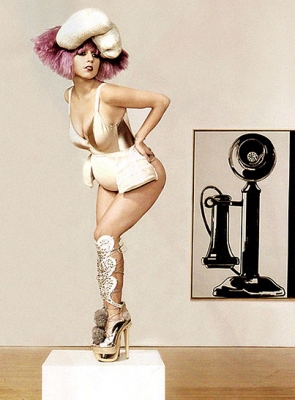
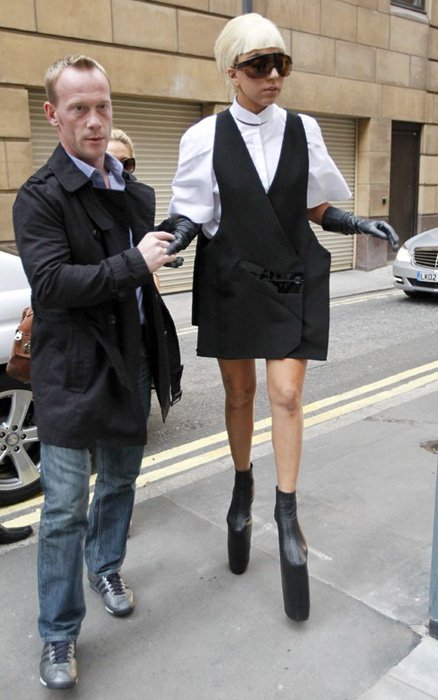
I want to address the critique of Gaga’s “weirdly attired feet,” because I for one am obsessed with her shoes. It seems relevant to bring up performance artist Vanessa Beecroft again, a female body artist who enlists models to stand in galleries, gawked at by spectators, nearly nude in impossibly high heels for hours until their feet bleed. Sometimes they pass out.
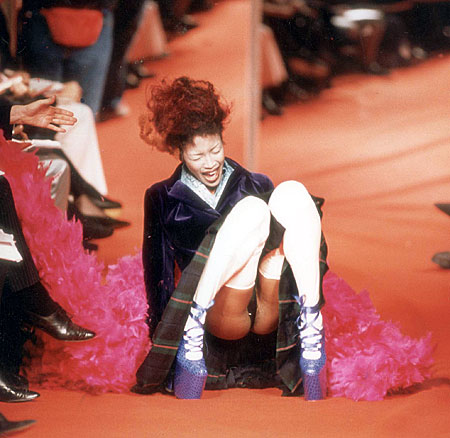
Models suffering through a Vanessa Beecroft performance / Naomi Campbell eating it on the runway
Like Beecroft’s girls who are performing cultural expectations for models and allowing the viewer to see the intense physical suffering (usually hidden behind the scenes) that their roles require, Gaga is - as a performer of fame, as meta-pop star - allowing the world to watch her “suffer” for her pop stardom daily, as she costumes her feet in impossibly heavy and monstrous footwear.
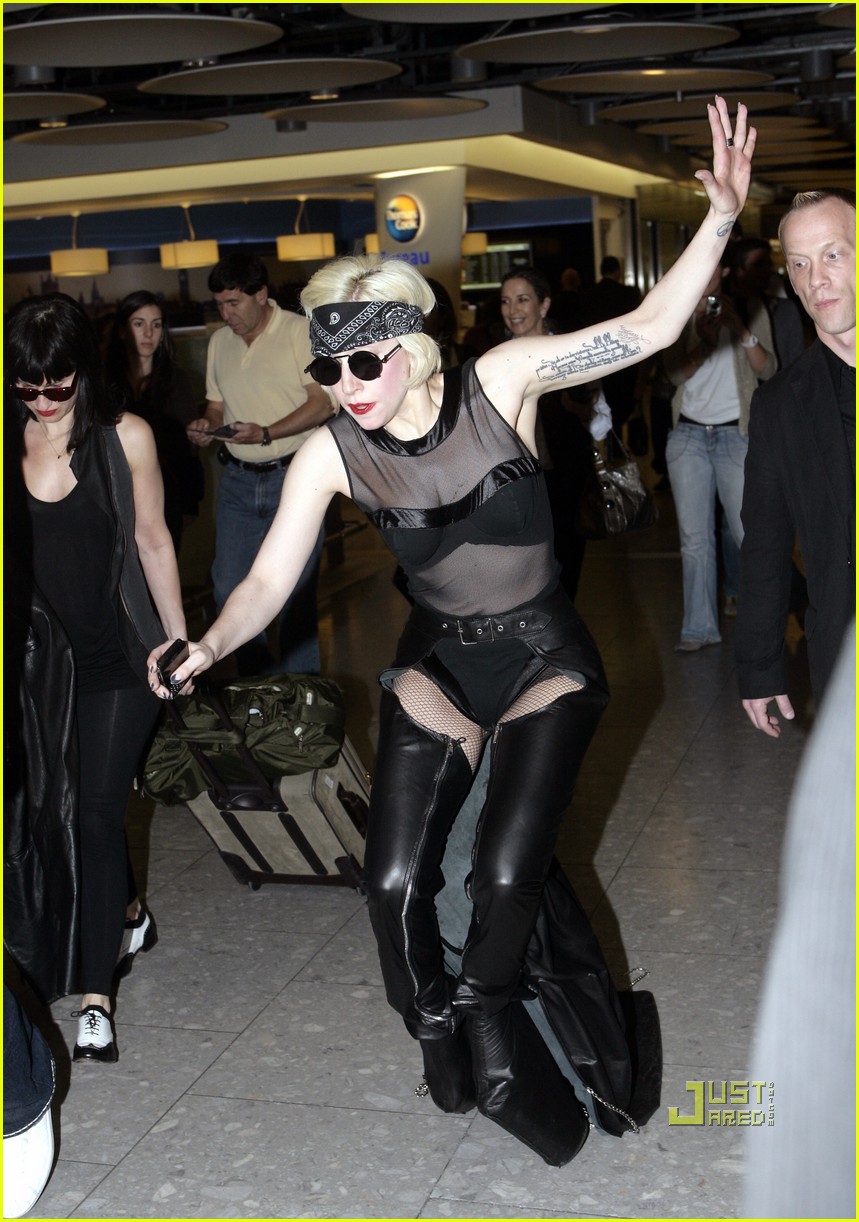
Gaga eating it in the airport
Gaga is literalizing what is considered sexy for women - high, high heels - to a grotesque degree. Think models falling down on runways, think Barbie’s shoes, how Barbie’s feet are perpetually curved, how Barbie would fall over if she really had those proportions. Think Chinese foot binding. And Gaga alters her feet at risk to her own well-being, even falling down at times. Once again, it’s important to note that Gaga is always Gaga - her life is her lie is her art, she falls for it every day.
What Gaga is doing with her footwear is more than just critiquing painful beauty expectations for women generally and pop stars specifically. Gaga sees suffering for one’s art as a positive thing, suffering as a way of transmutation. The pain Gaga’s feet experience is a price to be paid in order, like the performance artist Orlan who has undergone numerous plastic surgeries in service of becoming post-human, to evolve.
Orlan during one of her surgeries
The shoes make Gaga robot, cyborg, monster, lizard, alien, at various turns. Her paws (which neatly complement her monster “claws” ) were created by Alexander McQueen, known for his future-driven couture visions that merge the animal and “natural” in gorgeous, grotesque ways. The shoes appear practically fused to her body, a part of instead of apart from her. They are the lie she’s told over and over in order that it might become the shoes. And as for the pain the shoes inject, as Gaga said of her bleeding costume at the first VMAs: “When I bleed my clothes bleed too.”
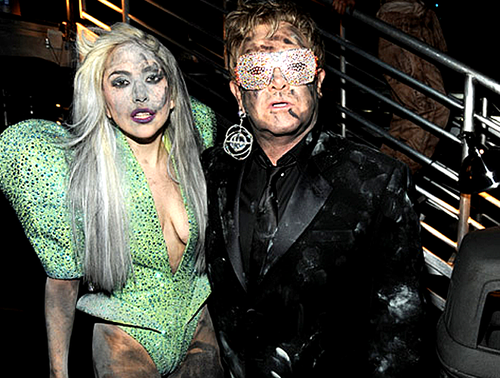
Gaga claimed the original Monster Ball’s concept was about the evolution of civilization and biological evolution, and her albums The Fame and The Fame Monster dealt with the monstrous evolution of the pop star. Her performances have evoked death and rebirth countless times, from her first VMA performance to her performance with Elton John at the Grammys, in which she wore a lizard-like garb and was ejected from a factory chute in order to become a monster, to her Paparazzi video where she falls to her death and resurrects as a disabled, murderous super star.
Gaga’s art and activism (which are the same thing) are all about political, (pop)cultural, and sexual mutations and monstrous re-births. Are these sorts of social (r)evolutions not inextricably linked to biological evolution? As Meghan pointed out earlier, Gaga’s project is important because Gaga is about taking siege of her own identity, giving monstrous birth to herself over and over, like the recent visual piece, "A Special Variety of Soft Skinned Dangerous Game," by artist Jemima Wyman for Gaga Stigmata. Part of that birth is moving with technology instead of against it, part of that is actually morphing her features, the physical possibilities of the body. And birth, as well as beauty, historically have always been tied to pain - not just pain for the sake of prettiness a la getting a breast enhancement to please the Male Gaze and live up to painfully limiting cultural expectations, but pain for the sake of beautiful evolution; the evolution of beauty.
Camille Paglia vs. Lady Gaga
The criticism: Lady Gaga is scripted; she’s not spontaneous. “Lady Gaga is a manufactured personality, and a recent one at that. [...] The Gaga of world fame, with her heavy wigs and giant sunglasses (rudely worn during interviews) looks either simperingly doll-like or ghoulish, without a trace of spontaneity.” - Camille Paglia, The UK Sunday Times Magazine
Lesley Kinzel: You know, to me, Paglia’s entire article reads like a lengthy screed for those kids to get off her lawn. It’s perplexing! This part in particular was baffling: Gaga is hardly the first person to use a manufactured personality or heavy wigs or giant sunglasses to distinguish herself, nor is she the first to keep her sunglasses on during interviews. Would her lack of spontaneity be acceptable to Paglia if she had been doing it longer? Are stage personas always a problem in Paglia’s world? This excerpt reads as though Paglia is chiding Gaga for failing to be authentic, oblivious to the glaring fact that playing with (in)authenticity is a large part of the point.
Kate Durbin: I completely agree with Lesley’s statement that “(in)authenticity is a large part of the point” of Gaga’s project. This reminds me of a parallel critique of Gaga that I encountered in my interview with CBC’s Q, when Gaga was considered by the host of the program to be unoriginal as a musician, manufactured. But Gaga’s project as a meta-pop star requires that she appear to be manufactured to some degree, because she is commenting upon the world we currently live in. She couldn’t be a meta-pop star without “cliched” (perhaps ubiquitous would be a better word) pop star music, and that music had to be comprised of number one hits like Spears’ hits a la literally “Oops I Did It Again.” If she was trying to be “original” - which is impossible anyway - she would have actually been a less interesting artist, frankly. The pursuit of originality is impossible, a modernist notion that buys into the lie of “progress.” And it’s boring to boot.
I see the wigs and sunglasses as part of this as well - Gaga is referencing all these pop stars and fame monsters from Michael Jackson to Princess Diana as a part of her fame project of (in)authenticity, and she is also mirroring and mimicking those she comes in contact with such as Larry King and the Queen, drawing attention to the fact that nowadays all of life is a role, that the street is the stage. Gaga talks about the lie of her work - lying until the lie becomes the truth. What Gaga understands about our zeitgeist is that it’s all a lie. Modernism and progress were a lie and now identity itself is a lie but because these ideas are all lies, we can in effect name them and claim them, putting on the lies that best suit us in order to costume our own truth.
I also agree with Lesley that Paglia’s critique really sounds like the bitter grumblings of the old guard. I think we can safely assume she just doesn’t get it, or us - us being the little monsters, who are authentic in our passions, but want more options available to us than suffering for the illusion of one fixed identity, that of something pure and spontaneous and anti-technological and “organic.”
Lesley Kinzel: Speaking of being “authentic in our passions,” I want to mention Gaga’s YouTube video demonstrating her (ultimately failed) attempt to reach her senator to lobby for the repeal of DADT. Gaga displays an unexpectedly intense earnestness as she reads a speech (seemingly from a laptop off-camera) and then spends the last three minutes listening to her Blackberry fruitlessly ringing Chuck Schumer’s office. When the line goes dead, unanswered, after having sat staring blankly for countless rings, Gaga smiles at the defeat.
And then she tries again.
It would have been easy, understandable even, if this video never saw the light of day, considering that even when Gaga finally reaches Schumer’s voicemail, a recording instructs her that the mailbox is full. Instead, it’s posted and we get to share this odd little experience, mundane in its familiarity and yet weighted with anticipation that we will be privy to a private conversation between Lady Gaga and her senator. It’s bizarre in its existentialism. Don’t we love it when stars are just like us.
I’m a fan, if that weren’t obvious, but even I was a little astonished by this video. In it, Gaga is eager, unsure, even awkward, and these are not sides of her we usually see. Watching Gaga make this call and put herself out there as caring deeply about this particular issue makes it accessible and real. While Gaga may be a meticulously constructed personality, that does not make her not real. The takeaway is that an obsession with the superficial does not erase an ability to care deeply about issues - to be passionate.
Paglia argues that Gaga is dispassionate, unspontaneous, and insincere; I argue that Paglia has not seen enough of Gaga to make this case. This is a woman capable of both wearing a dress too heavy to walk in, and also of emphatically pleading with the United States government to commit to social justice on DADT in a video with production values so low it was obviously something thrown together at the spur of the moment. Neither, to me, rings hollow, and the one does not cancel out the other.
Kate Durbin: Gaga’s video didn’t read hollow to me, either, Lesley. Like you, I was moved. But it did read as performative, as performative as anything I’ve seen her do. I would be surprised if she didn’t do a run-through beforehand, and didn’t know ahead of time that the senator wouldn’t answer. Gaga’s patriotic outfit with her ever-present drag makeup seemed intentional, and just goes to show how politics are a drag show. The flag in the background, even the utilizing of her full “real” name, therefore rendering all politicians’ names stage names, yes, even the awkward pauses, felt as much a performance as her TV performances, which she relentlessly scripts and practices beforehand. We associate these things with authenticity because they are American and familiar, but one of the things Gaga does so beautifully is call attention to how the characteristics of America itself are bizarre and campy. Her Telephone video is another great example of this.
Her video to the senator is also interesting because, theoretically, we should all be able to get through to our senators. If Gaga can’t, we sure can’t. Her performance is pointing to a major problem - there is, in effect, no man behind the curtain. Just as with Gaga there is no Stefani Germanotta behind the curtain. But there is the power of the performance, something Obama himself utilized in his campaign to great success.
Like you, Lesley, I think Gaga projects something that is so passionate, and more (beyond?) authentic than those who claim to be authentic, and that is what I connected to in this video as well as in her red carpet performance at this year’s VMAs, when she walked the white carpet with the four discharged gay service persons. I actually wept when I witnessed that. Perhaps by revealing the performativity of life itself, how ideals and values can be performed every minute, Gaga reveals how these things can be tools that can serve all of us in order that we can perform what really matters - compassion. And, consequently, she reveals how the old methods - whether technological (i.e. the perpetually busy telephone line vs. the viral power of youtube), political (DADT’s hypocrisy vs. “If You Don’t Like It Go Home,” Gaga’s motto from her speech “The Prime Rib of America”), or otherwise (man/woman binaries vs. Gaga-esque polymorphous sexuality) - are failing us, with their false claims to spontaneity and authenticity and even goodness. They are just as much as charade as anything else, but their evil is that they pretend they are not charades. They parade themselves as the Truth. But they ring hollow, Liberty bell, because they are.
Lesley Kinzel: The makeup and the flag in the background truly made this video for me. It’s true - Gaga doesn’t really do irony so much as she does flamboyant reproduction, much in the way that drag is an amplified performance of gender. Both require affection for their origins. I loved it. I think her performance is often confusing to many because culturally we have a predetermined idea of what “authenticity” looks like - it’s a serious face, a dark suit and a red tie. When Gaga dares to bring a Big Issue to the VMA red carpet, a space that is nearly-always lighthearted, that performance is disarming, especially when she does not “use” her dates as clever props (I’m thinking of Gwen Stefani and her abhorrent exploitation of her “Harajuku Girls” years ago) but strictly sticks to her purpose of drawing attention to the injustice of DADT.
I most love that Gaga does not seem to be at all invested in the normal signifiers of someone who wishes to be “taken seriously”. She will advocate for GLBTQ rights with a live chicken strapped to her nethers, if she gets the chance. As an activist myself, there’s a lot of grand inspiration there.
The criticism: Gaga is not sexy. “Furthermore, despite showing acres of pallid flesh in the fetish-bondage garb of urban prostitution, Gaga isn’t sexy at all – she’s like a gangly marionette or plasticised android.” - ibid
Kate Durbin: I think that the criticism that Gaga is not sexy is actually more of a reaction to Gaga being inappropriately over-sexual, as opposed to, say, being “a-sexual” or “non-sexual” (whatever that means). Paglia critiqued her for wearing lingerie to the gym. Only a “sex addict” would wear such a thing to the gym, presumably.
What I love about Gaga and sex is that she displaces it - takes it out of familiar spheres, and parades what is normally hidden out in broad daylight. A recent tweet by Gaga would likely piss off Paglia even more. She said: “I’d wear any of my private attire for the world to see, but I’d rather have an open flesh wound than be caught with a bandaid.” This is part of her art. Her over-the-top sexual attire matches this attitude. She is different than, say, Madonna in this way. While Madonna may have pushed the boundaries of sex in her music videos and on stage, Gaga parades it on the street, at the gym. Places where her fans go, where we all go. It’s this context that rubs Paglia the wrong way, and it’s precisely this context that makes what Gaga’s doing important and dangerous to some. In part, because it is something you or I could do, if we had the guts and proclivity. To wear one’s sexuality - wounded as nature itself is wounded - out in broad daylight as a pair of hot pants is a really beautiful freedom, one that does not yet exist in our culture.
Gaga on her way to the gym
The idea of the grotesque seems relevant here as well - grotesque not as ugly, but so beautiful as to be almost too much to bear. Like the most incredibly intense orgasm! Gaga’s sexuality is so grotesquely sexual as to be “too much,” even death-driven. Think vagina dentata (and now I am thinking of Gaga’s fear that someone will take her creativity from her through her vagina, how that statement flips the whole vagina dentata notion on its head, yes, pun on head).
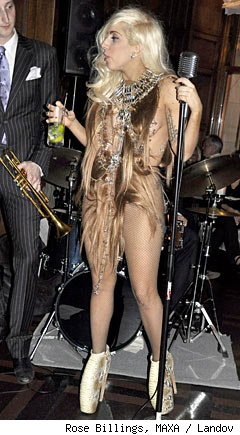
Gaga is not sexy in a containable feminine sense, like, say, Britney Spears or Katy Perry. She is excessively poly-sexual. See Gaga with the dildo in her pants on the cover of Q, see Gaga looking sexy as hell as Joe Calderone on the cover of Vogue Nippon, see Gaga covered in a dress of [pubic-looking] hair at a nightclub in NYC recently. Her sexuality goes beyond human sexuality to the realm of raw animal sex, which of course makes me think of Angela Carter’s feminist fairy tales, her wolf-women with voracious sexual appetites. Her sexuality goes beyond animal sex even to protean sexuality, cells merging with other cells. There are undertones of S&M and torture porn in many of her magazine shoots - “deviant” sexualities that speak to the inherent violence of sex, a violence that is a part of nature itself. There is, yes, the android sexuality, the sex doll quality of Gaga - but more in the sense of blurring the lines between the natural and the unnatural, in that nothing is natural or everything is natural, the dildo has simply become the doll. She complicates our notions of the sexuality of those with disabilities - our notion, even, of whether or not a disability is in fact a disability or rather a possibility - with her wheelchair performances and in her Paparazzi video when she dances with crutches and a helmet. Gaga’s sexuality is liquid, ever-present, never revoked to the bedroom, always evoking the ubiquitous sexuality of sheer physical existence on this planet! And frankly, I think it’s hot.
Gaga posing with a dildo and chains for Q Magazine / Talk about green porn! The sexuality of crystalline growth
Meghan Vicks: I love the idea that Gaga injects sex into traditionally-sexless spaces. It’s a way of making strange and defamiliarizing both sex and those public places where sex is not supposed to belong. Nevertheless, the public space is ridden with sexual images in that advertising often capitalizes on sex appeal. But those sexual images in advertisements are so ubiquitous and familiar that we don’t notice them all that much - they’re part of the background, or the white noise of urban existence. So when Gaga suddenly steps out without pants to buy coffee, the sexual figure becomes immediately present and recognizable: it’s brought from the background into the foreground, comes into focus from its ubiquitous oblivion.
Regarding Paglia’s specific complaint - that Gaga just isn’t sexy - I have to assume that Paglia has some secret sexiness decoder ring that I haven’t yet learned about. We know standards of beauty are variable and fleeting and fluxing, that what “counts” as beautiful isn’t the same over time, or culturally universal; the same applies to what’s sexy.
So Gaga doesn’t get Paglia off - and the point is?
What seems to bother Paglia the most is that Gaga’s sexuality is sterile and non-reproductive - it’s plastic, android, puppet-like. While I agree that Gaga does, at times, perform a robotic and celluloid sexuality, I can’t understand why Paglia’s only reaction would be a disgruntled “UGH! Not sexy!” echoing throughout the Internet’s ether. Because I wanna ask: what’s potentially problematic about a plasticized sexuality? Isn’t the idea of a plasticized sexuality a reflection of growing contemporary norms regarding the sexual body? Isn’t “plastic surgery” synonymous with “sexual body”? Don’t we hear silicone and think about breasts? And on the other hand, I would also pose the question: what’s potentially positive about plasticized sexuality? Can’t we see this sort of sexuality as liberating because it’s non-reproductive? It makes sexuality a pleasurable end in and of itself (think dildos, vibrators - all those plastic sex toys that cater to and worship one’s sexual pleasure). So there’s a number of interesting ways to think about how Gaga presents the sexual being, and while Paglia may be right in her diagnosis of Gaga’s sexuality, I disagree with her assessment of it.
Lesley Kinzel: I wholeheartedly agree with the points you both raise above. Still and all, my kneejerk response to this quote when I initially read it was, “...and who made Camille Paglia the supreme arbiter of what counts as sexy?”
In the same section, Paglia also calls Gaga’s brand of sex “clinical and antiseptic,” and to some extent I can get with her there. However, to argue, as Paglia does, that this is somehow deviant from mainstream sex seems incredulous. Contemporary sex involves such inventions as Real Dolls, and the sex-as-concept that Gaga (and most of us in our thirties as well!) have grown up with has always been couched in terms of “safety” and barriers and latex and prevention. A “clinical and antiseptic” approach to sex seems understandable enough to a generation who know the experience of an HIV test, or a Hep B vaccine. I reckon our contemporary culture of sex has been infused through and through with these ideas, and Gaga is simply turning up the volume on that.
---
Dear Readers,
We'd love for you to join this conversation, and tell us your thoughts on the various issues we discuss. Or: give us your definition of "Gaga's Feminism" in 50 words or less!
Cheers,
Gaga Stigmata
Kate Durbin: Kate Durbin is an L.A.-based writer and performance artist. She is the author of the poetry collections The Ravenous Audience (Akashic Books, 2009) and, with Amaranth Borsuk, Excess Exhibit, forthcoming from ZG Press. She has written several chapbooks including Fragments Found in a 1937 Aviator's Boot (Dancing Girl Press, 2009), FASHIONWHORE (Legacy Pictures, 2010), and Kept Women, forthcoming from Insert Press. She writes about celebrity style at Hollywood.com and teaches courses on writing and monster theory at Whittier College.
Lesley Kinzel: Lesley Kinzel is a working activist and recovering scholar, both in the realm of gender and body politics, with a healthy side portion of media criticism and popular culture. She has been engaging with fat activism in particular and social justice politics in general for the better part of a decade, and her efforts to talk about fat really loudly with as many people as possible have included writing for venues as diverse as Newsweek, Marie Claire, and Geez. Lesley is currently writing her first book -- on being a radical fatass -- for The Feminist Press, and it is due to hit shelves in early 2012. She blogs at Fatshionista.com.
Meghan Vicks: Meghan Vicks is a doctoral student of Comparative Literature, currently writing her dissertation Narratives of Zero: Writing Upon Nothing in Modern and Postmodern Literature. In addition, she holds a graduate certificate in Women and Gender Studies, and has presented her work at a number of academic conferences on feminist issues, including Kathy Acker’s writings and abortive feminine identity, Boris Pasternak’s bisexual aesthetics, Toni Morrison’s racial and feminine performativity, and the cultural politics of Russian cyber-brides. She has taught various Humanities courses at the University of Colorado, and blogs at Only Words To Play With.