Tuesday, 15 March 2011

Like Madonna

By Connie A. Lopez-Hood


          for Lady Gaga

She wears horns
She is hatched

She is (not) like Madonna
She is (not) like Beyonce
She is (not) like Christina
She is not like Brittany

She was hanging from a cross
She was dripping lots of blood
She was dripping, draping meat

She is Dada
She is daddy
She is (not) mommy
She is Gaga
She is gagging
She is super(ficial)

She is assemblage
She is (dis)assembled
She is abject
She is eject
She is reject(ed)

She is gendered
She engenders
She is androgyne
She is a(borted) fetus
She is probably chromosome

She is covered with costume
She is covered with custom
She is covered in carnal
She is (not) herself

She wore horns
She was hatched

She hangs (from) a cross
She is (not) like Madonna
She drips blood
She drapes meat
She is (not) (her)(self)


Author Bio:
Connie A. Lopez-Hood is currently working on her MFA in Poetry at Cal State University San Bernardino. She serves as a Poetry editor for Ghost Town literary magazine. Her work appeared in Our Stories Literary Journal as a runner-up for the Gordon Flash Fiction Contest and is forthcoming in Polari Journal's April issue. She is currently working on a chapbook collaboration entitled Operation: Lifted Flowers, with two other Inland Empire poets.

Monday, 14 March 2011

Happy 1st Birthday Gaga Stigmata!

Saturday, 12 March 2011

Gaga Stigmata News


Some exciting announcements!

  • The amazing Nicola Formichetti, one of Lady Gaga's principle stylists and creative directors, tweeted on February 8, 2011 a link to Meghan Vicks' piece, "Anatomy of Fashion." We are incredibly thrilled and honored that a person from Gaga's most inner circle has acknowledged our work.

  • The Atlantic cited Meghan Blalock's piece that analyzes the Alvin Ailey elements in Lady Gaga's Grammy performance of "Born This Way." 

  • Editors Kate Durbin and Meghan Vicks' article "From The Fame to Born This Way" was featured on the front page of the March 4, 2011 edition of Berfrois: Intellectual Jousting in the Republic of Letters.

  • Kate Durbin was interviewed for a piece on Lady Gaga by The Voice-Tribune, published March 10, 2011.

  • We recently wrapped up our initial series of analyses on the video for "Born This Way," but are still accepting submissions that examine the video from new angles. If you are interested in participating in upcoming series on Lady Gaga's videos and/or performances, please contact Meghan Vicks at gagajournal@gmail.com. Include in your email a resume/CV, and a sample of your own Gaga-related writing.

Thanks to all for your continued support of Gaga Stigmata!


Click here to follow Gaga Stigmata on Twitter.
Click here to “like” Gaga Stigmata on Facebook.

Thursday, 10 March 2011

Apotheoses of the Queen Mother: The Virginal Monster

By Chris Hershey-Van Horn

The following piece is the tenth in our series on Lady Gaga’s video for “Born This Way.” Click here for our previous analyses of the video.

Lady Gaga’s video for “Born This Way” presents a wealth of meaning-laden imagery, the majority of which arguably resides within a symbology fundamentally correlated with the iconography of Queen Elizabeth I – the so-called “cult of Elizabeth.” Yet, I would argue that Gaga turns the apparatus of Elizabethan iconography on its head: she functions as a “nega” or “anti” Queen Elizabeth, insofar as Gaga’s mechanism of gendered expression inversely parallels that of the Queen’s. She does so on multiple symbolic fronts. In this piece, I first examine how Gaga initially establishes herself referentially (if not reverentially) to the Queen in the opening seconds of the video. I then explore the concept of the “grotesque” female in sixteenth century England, the many ways in which the Queen sought to actively distance herself from such negatively-gendered associations, and how Gaga conversely embraces and refigures the concept of the “grotesque” female for the twenty-first century.

The opening images of Lady Gaga in the video for “Born This Way” contextualize her within the distinct aesthetic of Queen Elizabeth I. Following the brief frame of the silhouetted unicorn, the camera pans downward and zooms in on the celestial embodiment of Gaga. She sits poised atop a crystalline throne, her upper body draped in a seemingly endless display of opulent jewelry, cuffing her neck in a tall collar of diamonds. Our gaze is drawn immediately toward the top-middle of the frame, where a large black cross – its horizontal axis encrusted in diamonds – perfectly intersects her large, beehive hair, and joins with a diamond tiara about her bangs. Behind her, an exaggerated, butterfly-shaped headdress merges with the ray-like spokes of blue and purple crystal prisms. The headdress, the tiara, the hair, and, of course, the throne, evoke a regal aesthetic, which, although futuristic, distinctly draws upon the imagery of Elizabeth I.


Marcus Gheeraerts the Younger, Elizabeth I (the “Ditchley” portrait), (ca. 1592)

Artist Unknown, Elizabeth I (the “Rainbow” portrait), (ca. 1600-1603)

The butterfly-shaped crystalline headdress evokes the Queen’s iconic elaborate headdress as seen in the “Ditchley” portrait and, most famously, the “Rainbow” portrait. The cross on Gaga’s hair links her well-known employment of religious symbols with the underlying religious symbology of the Queen as “the Virgin Queen,” and emphasizes the Christian references in the song’s lyrics (“captial H-i-m…God makes no mistakes,” and the quietly spoken “church” that can be heard in the background). Furthermore, Gaga, or rather, “Mother Monster” as she refers to herself in the opening line of the video, connects herself linguistically to the Queen “Mother,” and again, the Marian “Virgin Queen.” Yet, as we will see, this connection is fundamentally paradoxical.

Before we can delve into comparative analysis, I must concede a point. It would be a fallacy to posit an overall view on the cult of Elizabeth and her varied and extensive iconography. As the ever-expanding mass of scholarly work attests, it is no simple task to do discursive justice to the religious and (to use Susan Frye’s term) “engendered” imagistic framework with which the Queen presented herself over her prolonged rule. As Louis Montrose argues in The Subject of Elizabeth (2006), “the iconography of the Elizabeth cult was not a unified and coherent system but rather was hybrid and improvisatory – therefore unstable and potentially contradictory,” as it “drew upon various sources in varying combinations at different moments in the reign, to suit the tactical circumstances of particular occasions” (104). The task of unpacking Elizabeth’s iconography and the extensive symbology associated with “the Virgin Queen” teems with a sheer enormity of accounts and artifacts, of contradictory and even unsubstantiated material. In short, her image cannot be wholly or manifestly delineated; it is amorphous insofar as it exists and existed during her reign as ever-changing in her eyes, as well as in the eyes of her countrymen. Arguably, the examination of Lady Gaga’s extensive iconography presents an equal challenge for similar reasons. Heeding all of this, I believe it is still intellectually advantageous to consider at least a smattering of images within the context of the pervasive sixteenth-century concept of the “grotesque” female, as it pertains to the Queen and Lady Gaga’s music video.

In Peter Stallybrass’s article “Patriarchal Territories: The Body Enclosed” (1986), he explains the concept of the “grotesque” female, and how this notion influenced ideas and ideals of gender in Renaissance England. Drawing upon Mikhail Bakhtin’s concept of the grotesque body, Stallybrass explains, “the grotesque body is ‘unfinished, outgrows itself, transgresses its own limits…[and] emphasizes those parts of the body ‘that are open to the outside world,’ ‘the open mouth, the genital organs, the breasts, the phallus, the potbelly, the nose’” (124). He goes on to argue that it was a commonly held societal belief, as purported by several Renaissance writers of the time (such as William Whately and Norbert Elias), “that the woman’s body…is naturally ‘grotesque’” (126). Unlike men, women, by physiological default, were cursed with a kind of reprehensible permeability, a leakiness of the body, if you will. The only solution to this “natural” problem was containment, to make the woman into an “enclosed body, [a] closed mouth, [a] locked house” (127).

Not surprisingly, virginity was inextricably linked with the concept of the “grotesque” – as a way of alleviating the grotesque, of containing this “reprehensive permeability.” This is why, at least on one level, Queen Elizabeth I strove to carefully craft and painstakingly maintain her image as the “Virgin Queen.” As a woman of great power and publicity, there was simply too much at stake; in the eyes of the public at large, the Queen would debase herself and be unfit to rule were she to be perceived as a “leaky vessel.” Susan Frye, in her book, Elizabeth I: The Competition for Representation (1996), puts it eloquently.

Elizabeth could never rely on others to provide her with an iconography that would be palatable, much less powerful…She also needed a category that would be familiar to her society but that would place her beyond the restrictions usually imposed on women…she needed a category of virtue that she herself would define, that would assign God, rather than her subjects, to be her judge and thus assert her legitimacy. (15)

Elizabeth found this “legitimacy” in “the long tradition of anomalous female figures, including Diana, Astraea, the vestal virgins, and the Virgin Mary” (15). Since virginity – especially one symbolically tied to divine or mythologized female figures – was considered a “hortus conclusus” that could negate feminine permeability, it could also repudiate subsequent ridicule that the Queen would face as a part of her “naturally grotesque” gender. Her famous statement, made a mere month after her coronation, that by the end of her reign she will have “lyved and dyed a virgin,” is testament to her personal agency, and to the importance with which she regarded the establishment of her ideal virginal image. Stallybrass explains that as a female, “she could be the idealized beloved, to whom was ascribed the devotion of amatory discourse. But, on the other hand, she belonged to an anomalous category, being both mother of her people and virgin” (133). The Queen was playing something of an elaborate balancing act of engendered signification to appease her people and assert her legitimacy, despite and paradoxically in conjunction with her womanhood.

Examples of her idealized image can be seen in much of her portraiture. The Siena, or “sieve” portrait (ca. 1580-83), makes use of a literal sieve held in the Queen’s left hand. It evokes her “grotesque” permeability, as fundamental to her womanhood, while putting it in direct contrast with her conservative attire. In this way, according to Montrose, the sieve, a “contradictory icon, one that must represent the properties of impermeability and (selective) permeability simultaneously” serves to potentially “[displace]…the Queen’s sexuality” insofar as it highlights the Queen’s conservative and constrictive manner of dress (124-5).

Artist Unknown, the Siena “sieve” portrait, (ca. 1580-83)

In her “Born This Way” video, Lady Gaga also asserts her legitimacy as the symbolic progenitor – the divine mother and overseer of her people, who constitute a “new race within the race of humanity” through the fundamentality of her womanhood. Yet, to the extent that Queen Elizabeth I symbolically “contains” her “grotesque” body, Lady Gaga embraces it, makes it profoundly blatant, even exaggerates her “grotesque-ness” in a vivid display of orifices, bodily fluids, and excessive vaginal drippings. Gaga is relentless in her show of leaky bodily goop – the essence of herself, her vagina, her womanhood.


Gaga’s nude zippered bodysuit furthers the iconographic model of the cult of Elizabeth. Much like the aforementioned Siena portrait pictured above, Gaga’s tightly-zippered body conflates restriction with access. As the camera slowly pans up and down her body, it quickly jumps between short frames of Gaga slowly and mechanically moving as she gyrates her hips, robotically raising her arms up and down, and groping herself. Notice how she is by-and-large rendered immobile, unable to move from her position by the stock-like contraption bracing her neck. The contraption horizontally spans the entire width of the frame. Furthermore, the zippers on her body literally underline her breasts and vagina, emphasizing her womanhood and sexuality. However, the fact that these zippers are closed reinforces the containment of the body, specifically her biologically-stereotypical “female” components. Similarly, the last frames of zippered-Gaga involve an elaborate effect in which the camera rapidly pans from a centrifugal and repetitious frame of her face to a similar frame centering on the vaginal crotch zipper. All of this – the methodical and constrained choreography, the constrictive suit, the camerawork – can be viewed as a caricatured Elizabethan-cult model of virginal and womanly paradox, which mocks the “solution” to the “grotesque” woman. Gaga reiterates her sexual purity through her closed-up-ness, while artfully calling attention to her body as a stark canvas lined with, and perhaps, defined by, its sexuality.


Yet, her status as a deity does not diminish. Perhaps it is because of the elaborateness and the sheer extent of her “grotesqueness” that fix her in a godly realm beyond. Indeed, her psychedelic vagina resembles more of a colorful venus flytrap than anything even remotely human. It is comic and alien, an orifice seemingly unique to the divine Mother Monster. It is also miraculous, functioning as a kind of infinitely-birthing tract. In fact, Gaga forgoes the traditional notion of conception, as there is no evidence of any inseminating force. She is not the Virgin Mother, but Mother Monster. Certainly, associations with the Virgin Mary still underlie the image of celestial Gaga in this video. The abundance of religious references in the song and video suggest that Gaga’s progeny are not the result of Gaga alone. Like the Queen, she is not God, but rather godly, positioning herself over her people through divine and bodily legitimacy.

Therefore, “Born This Way” serves as a celebration of the “grotesque” through apotheosis. No longer is the body a point of shame; rather, it is a unique, divinely powerful, and humorous creative force. Lady Gaga’s display of exaggeratedly messy biological processes renders her divine; her abject serves as one of the defining characteristics of her transcendent power. In these ways, Gaga’s musical manifesto defines her own conception of motherhood and self-identity within a visual matrix of symbolic paradoxes in the vein of the Queen’s iconography. As the cult of Elizabeth blends together sexuality, gender, and physiology with the purity of the regal and ethereal, so Mother Monster is both the ultimate virgin and the ultimate mother. She is a symbolically defined “Queen Mother” figure who asserts power and influence through the infinite celebration, the infinite birth, and the infinite display of the body, and whose offspring subsequently assert their own legitimacy and power through the rejoicing of their own acceptance and self-identity. Unlike the Queen who withholds her identity within her iconography, Mother Monster’s “grotesque” identity is embraced as a means of empowerment.

Writer Bio:
Chris Hershey-Van Horn is Senior English and American Literature major at Middlebury College in Middlebury, Vermont. He is currently in the midst of writing his thesis, which, ironically or not, is a memoir. He is also an intern at Les Figues Press in his hometown, Los Angeles, and plans to move there after graduation.

Click here to follow Gaga Stigmata on Twitter.
Click here to “like” Gaga Stigmata on Facebook.

Wednesday, 9 March 2011

The Trajectory of the Monster: Some Musings on the Ascendance of a Myth and the Decay of the Female Celebrity

By Ella Bedard

The following piece is the ninth in our series on Lady Gaga’s video for “Born This Way.” Click here for our previous analyses of the video.

To periodize Lady Gaga’s work up to this point, I would rather consider the evolution of her music videos than her music. I say this not to dismiss Gaga’s music, but to suggest that we look elsewhere for the artistic intrigue in her work. If, like the editors of this journal, one gives credence to the view that Gaga is not simply a musician but a performance artist, then it is the juxtaposition between her seemingly formulaic music and the bizarre spectacle of the performer that warrants our critical attention. I have suggested elsewhere that Gaga’s remarkably typical pop sound is part of a greater performative statement about identity, cultural conformity, and celebrity. In this short piece, I consider how these themes are taken up in Gaga’s latest music video. In my psychoanalytic reading, “Born This Way” is a comment on the fragmented selfhood of the celebrity. The video reveals how fame creates a disparity between the Ego of “Mother Monster” and the female body upon which that myth is written. However, in order to glean this meaning from “Born This Way,” we must pay attention to the carefully constructed aesthetic of her performance, and how it has changed since the beginning of her career. For this, we turn to the videos.


If we consider the spectrum of Gaga from early videos like “Beautiful, Dirty, Rich” to later epics like “Telephone,” the trajectory goes something like the following. In 2008 and early 2009, when Gaga emerged with hits like “Just Dance” and “Eh, Eh,” she was fairly typical of the pop star type. There was something vaguely grotesque about her bow-hair, but nothing all that off-putting. At the very least, we could identify her by familiar cultural symbols: she had Italian heritage, she was young, she was confident, and liked to party. She was American – irreverently so. Also at that stage, Gaga was pretty unambiguous about her sexuality and gender. Her hips and heels identify her as female; the way she rubs them against her male interlocutors indicates her heterosexuality.


“Poker Face” delivered the first signs of gender ambiguity, which emerged more strongly in subsequent videos. Lyrics like “bluffin’ with my muffin’’ had Barbara Walter’s raising her eyebrows and asking questions about Gaga’s sexual history. Around this same time, a video circulated on the Internet that supposedly exposed Gaga as a man. The video shows her mounting a motorcycle during one of her performances. Apparently we see her penis slip out of her red booty shorts. Of course, the footage is hazy and confirms nothing. In later videos like “Telephone,” Gaga makes allusion to this hype, without setting the record straight.


Also at this time, we saw the emergence of cyborg feminist and post-humanist themes in Gaga’s videos. In “Bad Romance” and “Poker Face,” Gaga’s exudes a grotesque technological sexuality: hers is the smashed-up body where feminine flesh is inseparably twisted with cold hard robotic metal. In “Telephone,” Gaga appears in a skeletal cat suit with deathly white make up: she is woman, she is feline; she is alive, and she is dead. It is not only her status as woman, but also her status as human, that have been thrown into question.

                
To my mind, what is most interesting about Gaga is how she performs herself as a contingent site of citation. This is best encapsulated in the heavily collaged video for “Telephone,” where Gaga alludes to a plurality of possible identities without settling in any one. She has cultivated an elaborate aesthetic of pastiche, citing the style and sound of Madonna, Cher, and others. She is subversive and commercial, gendered and not, original and derivative. By continuously switching roles, she complicates these dualities and reveals how her identity, like any identity, is a contingency and a performance. She succeeds in her failing to play every part; she is unique only insofar as she acknowledges that her celebrity identity is a mimetic performance that draws on the gendered performances of her predecessors.

As a self-styled Fame Monster, Gaga’s acknowledges the extent to which her identity is constituted through the recognition of her followers. The ambiguities that surround Gaga reflect the myriad of contradicting sources that inform her identity. As her career progresses and Gaga becomes better known, we become increasingly less certain about what Gaga is. This is because Gaga is only the collage of photos and Internet rumors that constitute her celebrity. She is a reflection of the pluralized and fragmented field of information through which she appears for our consumption.

Though Gaga’s aesthetic has changed significantly over time, the theme of celebrity is ever-present throughout the disparate phases of her career. In my reading of Gaga’s work, fame is synonymous with Ego, and is used to illustrate the performative and socially constructed nature of the Self. In his psychoanalytic writing, Jacques Lacan famously describes the paranoid-narcissistic structure of the “I”. He argues that the Ego is specifically not the reality-mediating faculty of the individual, but a form of alienating misidentification. The person whom “I” recognize in the mirror – the self that is reflected for me in the other – has homogeneity and wholeness that “I” find at odds with my own disjointed experience of selfhood. One always feels the gap between herself and the seemingly totalized other that stands before her. As opposed to competing with the wholeness of her reflection, the subject alienates her sense of self to it. It is this alienation of self to our spectral other that allows us to look in the mirror and proclaim “that is me!” Yet that projected and imagined self will always be a lie – an ideal – that one strives for but continuously fails to embody. In an attempt to banish the feeling of lack at the core of our being, we seek affirmation, love, and recognition from the other.

As Gaga acknowledges in the “Manifesto of Little Monster,” she exists by way of the mutually constitutive relationship between herself and her fans.

So, the real truth about Lady Gaga fans, my little monsters, lies in this sentiment: They are the kings. They are the queens. They write the history of the kingdom, and I am something of a devoted Jester. It is in the theory of perception that we have established our bond. Or, the lie, I should say, for which we kill. We are nothing without our image. Without our projection. Without the spiritual hologram of who we perceive ourselves to be, or to become rather, in the future. When you’re lonely, I’ll be lonely too. And this is The Fame.

This manifesto reads very differently from the “Manifesto of Mother Monster,” which Gaga recites at the beginning of the “Born This Way” video:

On G.O.A.T, a Government Owned Alien Territory in space, a birth of magnificent and magical proportions took place. But the birth was not finite. It was infinite. As the wombs numbered and the mitosis of the future began, it was perceived that this infamous moment in life is not temporal, it is eternal. And thus began the beginning of the new race, a race within the race of humanity, a race which bares no prejudice, no judgment but boundless freedom.

Whereas the “Manifesto of Little Monster” acknowledges Gaga fans as the source of Gaga herself, the “Manifesto of Mother Monster” inverts the relationship, positing Mother Monster as first mover. In this creation myth, Gaga is the cause of the “new race” of little monsters. While the first manifesto explicitly acknowledges Gaga as a projection of her fans, the second manifesto denies this mutually. This is because the second manifesto is a performance of the projection. She is enacting the lie that she alludes to in the first manifesto – the lie “for which we kill.” And in fact, as we see in “Born This Way,” the negative side of this myth is destroying the physical body of Gaga, the site upon which the “spiritual hologram” is projected.

The moment the ego is constituted, a false dichotomy is created between the idealized ego and the failing self. This bifurcated “I” is the lens through which one perceives herself and the world: it is the constitutive distortion that will forever inform her perception of reality. The mythology that initiates the symbolic order of “Born This Way” introduces us to two Gagas: the good and the bad. However, when visually represented, the dichotomy is perhaps more accurate described as a division between Immortal Gaga and finite gaga.


“Born This Way” dramatizes the paranoiac-narcissistic symptoms of the fractured ego. As her celebrity grows, Captial-G Gaga becomes a more powerful, more intimidating Ego-ideal, which gaga can never live up to. The idealized Gaga sits bathed in light, surrounded by religious imagery. She is the “Spiritual Hologram,” the Gaga we constitute through our adoration. The anemic gaga who appears naked and in skeletal make-up is the negative image of that Goddess. As her Celebrity grows and the mythologized Gaga becomes a more powerful and convincing mirage, the disparity likewise increases between the idealized Ego and her finite counterparts, whom we see in varying states of decay.


The gaga who dances naked reveals the aggressivity buried in the narcissistic structure of the ego. There is something menacing about the way she moves. Whereas the added boniness on the face and shoulders of the eternal Gaga contributes to her regal expression, this same makeup on the dancing gaga gives us a different impression. We see how the desire to live up to her own image has taken its toll on the physical body of the celebrity. This gaga is what threatens the beloved Ego with disintegration. Likewise, in skeletal makeup, gaga dances freely, sometimes touching herself. She rejoices in the death of the Ego – that is, in her own death, which is the death of an impossible myth. She begs us to believe that she was born this way, while the visual juxtaposition between the two Gagas serves to undercut the song’s lyrics and fill them with irony. She is both Gaga and gaga, both Mother-Monster and the excess that disrupts the phantasm of the Ego-ideal. Simultaneously one and many, she exists somewhere in between, in that indiscernible zone between herself and her fans: and this is the Fame.

Author Bio:
Ella Bedard is a student of contemporary history, culture, and criticism in Halifax, Nova Scotia. This year she will be moving to Toronto where she hopes to pursue her interests in performance, gender ambiguity, and Gaga.

Click here to follow Gaga Stigmata on Twitter.
Click here to “like” Gaga Stigmata on Facebook.

Tuesday, 8 March 2011

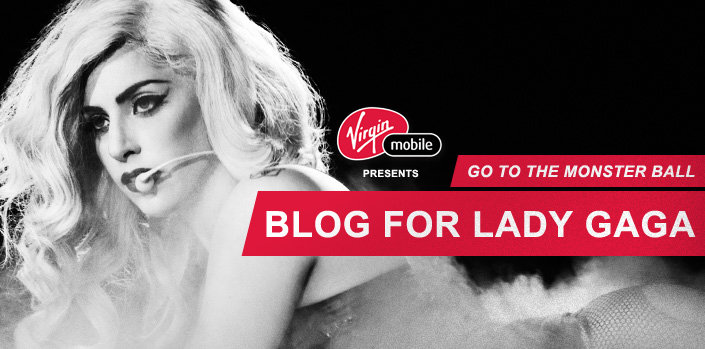
Blog for Gaga


Lady Gaga is kicking off her Monster Ball Tour 2011 and this is your chance to become part of it!

As the presenting sponsor of The Monster Ball starring Lady Ga
ga, Virgin Mobile has partnered with Talenthouse to find aspiring bloggers, video journalists and crazed fans that believe they have what it takes to join the ball.

Nine "Little Local Monster" bloggers will be chosen and will get:

· Attendance to a local Lady Gaga Monster Ball concert (dates and
locations below)
· Access to interview, assist and document behind the scenes of the
concert
· Time with Virgin Mobile's official Monster Ball 
Blogger, "Little Road
Monster" Dannielle Owens-Reid, the force behind 'Lesbians Who Look Like
Justin Bieber' and 'Everyone is Gay'
Contest Submission Details:

Submit a 1-2 minute video explaining why they should win by deadline for each city. Should be living near or willing to travel to the following tour stops:

· Las Vegas - MGM Grand, 
March 25th
· Phoenix - 
US Airways CenterMarch 26th
· Los Angeles - 
Staples CenterMarch 28th
· Houston - 
Toyota CenterApril 8th
· New Orleans - 
New Orleans ArenaApril 9th
· Miami - American Airlines Arena, 
April 13th
· Atlanta - Gwinnett Center, 
April 18th
· Nashville - Bridgestone Arena, 
April 19th
Shows in Las Vegas, Phoenix, Los Angeles
Submit by March 17
Voting starts March 17
Voting ends March 21
Announce March 23

Shows in Houston, New Orleans, Miami, Atlanta, Nashville, Uniondale
Submit by March 28
Voting starts March 29
Voting ends April 4
Announce April 6

Show in Newark (international comp)
Submit by April 4
Voting starts April 5
Voting ends April 11
Announce April 13

Ga Ga Glossolalia

By Devin O’Neill

The following piece is the eighth in our series on Lady Gaga’s video for “Born This Way.” Click here for our previous analyses of the video.

My problem with critical theory in a nutshell is that attempts at rationally deconstructing art are inevitably hamstrung by the fact that if what the artist meant to say could be expressed in denotative and linear language, the art wouldn’t have had to be made in the first place.

Damien Hirst’s diamond-covered skull is not saying anything explicit. It’s not saying “capitalism is death” or conversely “money is everything.” It can be analyzed after the fact, but that’s what criticism is: autopsy. That’s all. It has very little to do with the creative impulse, which is at least potentially irrational, a disruptive fact that the structured, source-citing arguments of critical discourse seem to skirt by simply not talking about it. I could attempt to write antirational criticism, but then it would just get called art and it would be published somewhere else. The skull is a meaning-bomb, not a meaning. This bit of an interview should clearly elucidate the gap between the critical and artistic processes. Granted, it’s only one approach, but the point is that it can’t be discounted as an alternative way of envisioning creative discourse:


There have been some strong reactions in the LGBT community to Gaga’s presumption at recording an “anthem.” Criticism of the anthem’s message, of course, must presuppose an understanding of what the anthem is saying. There are messages blazoned in big block letters across the song (the genetic essentialism of the “born this way” idea; the direct mentioning of queer subpopulations in the lyrics), and they’re taken at face value. These are the messages, by and large, being reacted to by the “Gaga doesn’t speak for me” demographic. To say with such emphasis that she doesn’t is to presume that on some level she’s trying to (and it’s to presume that she isn’t “you”; the disinclusion of Gaga as a member of the LGBT community in popular rhetoric continually confuses me. She’s hard, in my mind, to see as traditionally, heteronormatively straight. She’s at least genderqueer).

Reacting to a song and performance like “Born This Way” with straightforward, politicized analysis somehow seems a more cogent and aware method of systematized thinking than to react to a Captain Beefheart song the same way would be (this would be seen as reductive). But Gaga deceives (lies): because her lyrics are simple sculptures, with visible edges and directions, people give up on further interpretive depth. Is this their laziness, her design, an accident of the work’s construction, or some combination of the three? Whose failure or success is it that people don’t look closely at the ragged edges of these simple shapes?


This tension is brought to a head by the “Born This Way” video, and the possible trajectories and rhetorical touchstones embedded in these images bend the entire conversation about interpretive depth over and fuck it in the ass. We are experiencing pop mysticism here, and mysticism is generally (duh)ssociated with the transcendence of binaries. In addition, the texture and language of STYLE is a gateway to the infinite, explosive to analysis: since analysis involves a breaking-up of something into its component parts for a review of its functionality (from the Greek analusis), how small do we break up the globally and laterally affective images in this video? Do we meditate on the material of the threads in her birthing outfit? Opine on the pink color of her hair? Count the number of times her cunt-gun fires a bullet? Here we descend into the fractal apophenia of artistic psychosis, and not even William Blake can save us. In a stylistic exercise, which Gaga excels at, the infinite is in every thing.

But paradoxically, many of my colleagues have voiced frustration with regards to the reductiveness of the song and video: they don’t want to be a Gaga “clone,” they don’t want to be “born this way” – they want to transcend their biology. This discussion of transcendence of the biological is grounded in the static nature of the biological – an illusion. They themselves reinforce the binary by rebelling against its “nonexistence,” and in the process, blind themselves to the fractally textured potentiality for interpretation latent in the song and video. She tries to tell them – the birth is infinite. They don’t hear her, and they don’t hear Donna Haraway’s Cyborg Manifesto either. Gaga’s embrace of technology and augmentation of the body is a transhumanistic exercise. Her music could not exist without machinery, and she herself is to be modified and remixed: here she’s remixed her very self into two (un)equal and (non)opposite versions. The idea that she could be preaching biological immutability in the lyrics to this song is an assertion ignorant of her entire body of work and creative methodology.


Being free of prejudice in the larger sense is a necessarily mystical act, since it implies a shedding of the constraints of biosubjectivity: regardless of our liberation ideology, we are limited brains with limited perceptual and praxical equiptment. We achieve this goal of freedom from any prejudice only in death (if then). She is positioning god-symbols; lines of progression and worship, not attainable goals or objects. The infinite is integral to her practice and the infinite is not handled well by politicizing critics, whose positions require counterpositions structured in AT LEAST binary arrangements. Is this video an argument for binaries or against them? Shut up. It isn’t an argument at all. Argument implies limitedness, and she’s babbling the glossolalia of the forever, both verbally and visually.

The capital H-I-M in the song functions as a lighting rod for this mystical experience, just as all god-metaphors do. Further objections have been raised about the religious, and therefore presumably conservative, undertones of the song. Again, this perspective willfully blinds itself to her words, her images, basically all the rest of her art. That this is seen as a valid critical response is baffling to me. Contradiction and complication are Gaga’s constant companions, at the left and right hand of the mother. These are the weapons with which she continually deflects reduction, and in so doing, keeps us (and the media) interested.


Therefore, the only proper way to engage with Gaga’s work is to worship her like a deity. By this, I mean: regard her as an infinite entity proffering a trajectory toward transcendence. This act does not have to be mindless (not to discount mindlessness), it can be a purposeful and creative exploration of the potential of religiosity. This may be the source of some of the conflict between the little monsters and their critics: they see us as fanatics, and we are proud and ironic about our fanaticism. Or are we? Their bafflement only fuels us, just as bafflement must fuel the Phelps family or the denizens of 4chan.org. As Grace Slick said: you gotta find somebody to love. Or, at least, it’s a lot of fun. She is our Mother in this way, in her new video: a simulated, stimulated entity that offers us boundless connectivity and license for intimate joy and, at the same time, boundless freedom and the concurrent violence and pain of division and isolation. The binary symbols in the video are symptoms of the fact that in our current, un-ascended form, these trajectories are seen as antithetical, unable to be unified. But in the video, they are unified in Gaga. She does not need our linear reasoning to enable herself to exist as both.

So: who is anyone to assert that the linear, logical pursuit of an ideology of liberation in this context is a more valid critical method than doing a bunch of MDMA and just dancing to the song? I ask this as a serious question.

Author Bio:
Devin O’Neill is a writer, performance artist, PR practitioner, and compulsive liar (what’s the difference?) based in Long Beach, CA. He enjoys things he shouldn’t, on purpose, and tries to get other people to enjoy them too. Some of his projects can be found at http://www.popocalypse.com/ and at http://devinoneill.blogspot.com/.

Click here to follow Gaga Stigmata on Twitter.
Click here to “like” Gaga Stigmata on Facebook.

Compare hotel prices and find the best deal - HotelsCombined.com
Twitter Delicious Facebook Digg Stumbleupon Favorites More